

Hungry ghosts, p.1
Hungry Ghosts, page 1


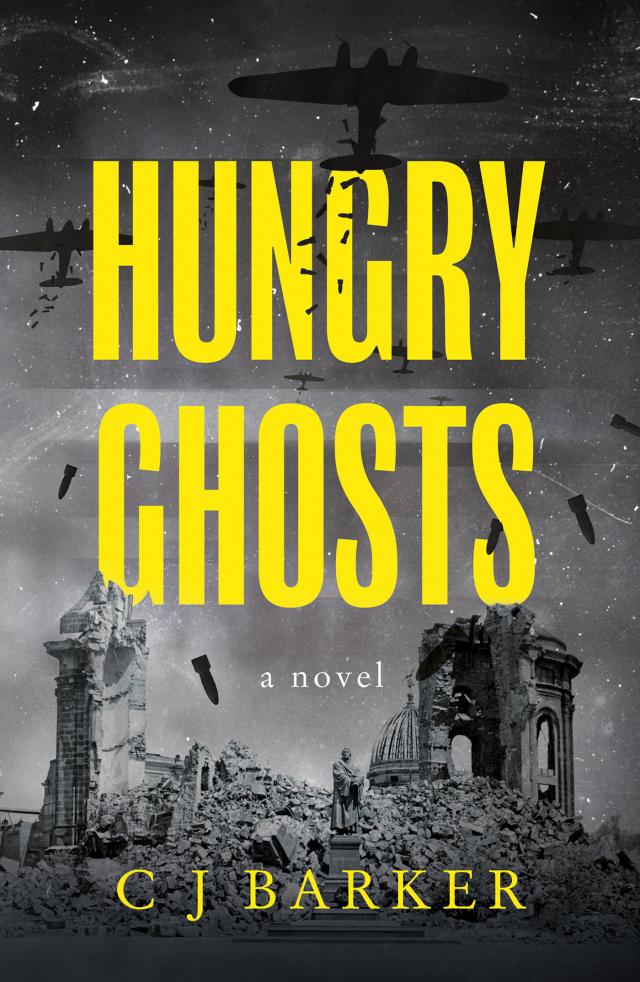
‘Hungry Ghosts brings twentieth century history alive in a story that artfully illuminates the impact of war and the counter-cultural revolution on those who experienced them.
Professor Sue Turnbull, University of Wollongong,
and Chair, BAD Sydney Crime Writers Festival
‘Chris Barker has produced a novel that you won’t forget. Engrossing, perceptive and highly inventive. - you will not notice time passing as you read it.’
Chris Rojek, Professor of Sociology and Culture,
City University, London.
First published in Great Britain in 2024 by
The Book Guild Ltd
Unit E2 Airfield Business Park,
Harrison Road, Market Harborough,
Leicestershire. LE16 7UL
Tel: 0116 2792299
www.bookguild.co.uk
Email: info@bookguild.co.uk
Twitter: @bookguild
Copyright © 2024 C J Barker
The right of C J Barker to be identified as the author of this work has been asserted by them in accordance with the Copyright, Design and Patents Act 1988.
All rights reserved. No part of this publication may be reproduced, transmitted, or stored in a retrieval system, in any form or by any means, without permission in writing from the publisher, nor be otherwise circulated in any form of binding or cover other than that in which it is published and without a similar condition being imposed on the subsequent purchaser.
This work is entirely fictitious and bears no resemblance to any persons living or dead.
ISBN 9781835740682
British Library Cataloguing in Publication Data.
A catalogue record for this book is available from the British Library.
To the past lives of my parents Molly and Dennis Barker
To the future lives of my children and grandchildren
Contents
Prologue
Part 1 World on Fire
Chapter 1
Chapter 2
Chapter 3
Chapter 4
Chapter 5
Chapter 6
Chapter 7
Chapter 8
Chapter 9
Chapter 10
Chapter 11
Chapter 12
Chapter 13
Chapter 14
Part 2 Things Fall Apart
Chapter 15
Chapter 16
Chapter 17
Chapter 18
Chapter 19
Chapter 20
Chapter 21
Chapter 22
Chapter 23
Chapter 24
Chapter 25
Part 3 The Times They Are A-Changing
Chapter 26
Chapter 27
Chapter 28
Chapter 29
Chapter 30
Chapter 31
Chapter 32
Chapter 33
Chapter 34
Chapter 35
Chapter 36
Acknowledgements
Prologue
London, 1968
James strolled past the rows of brightly lit photographs mounted on the crisp, white walls of The Barracks Gallery. The floorboards shone like cut glass, reflecting each image back onto itself like a hall of mirrors. It’s all here, he thought, twenty-five years of photography: “Vic Woods – World on Fire”, the full catastrophe of his father’s life.
He had finally agreed to accompany his mother, Ruth, to the exhibition after weeks of rebuffing her invitations. He was wearing the light-grey suit that she had bought him for the occasion. She had changed into a smart black dress, elegant heels to match, and a pair of dazzling earrings that danced around her head like fireflies.
‘These ain’t your regular earrings – they’re very old and very precious to me,’ she said. ‘They belonged to my mum, and they go way back in the family. They ain’t real rubies, of course, but who’d know.’
‘The Wolfe family legacy, eh,’ he said.
‘We all have them, Jimmy. That’s what families do; they hand down all their good stuff from one generation to the next.’
‘Along with their flaws,’ he said.
They inched their way through the crush of men in dark suits and women wearing posh frocks who were standing and chatting enthusiastically while they sipped colourful drinks from slender glasses. He was struck by the beauty and elegance of a petite young woman with tousled, curly black hair, wearing a tight-fitting bottle-green dress, and he instantly experienced a melancholy memory of Frankie. He wondered where she was and what she was doing. Probably surfing off Ocean Beach or rocking the night away to the Grateful Dead. He still missed her.
Mother and son squeezed their way through a shifting mass of anonymous bodies into a gallery simply entitled London, where a waiter approached them, carrying a tray of champagne glasses with long, thin stems. He smiled as he paused beside James.
‘Champagne, sir?’ he asked.
‘Thank you. I will,’ he said.
‘Me too,’ said Ruth. ‘This is a bit of a treat, ain’t it? I’m not used to this kind of luxury.’
James sipped the sweet, fizzy drink: a real pleasure and quite a buzz. As he held the delicate flute to his lips, he stared, amazed, at a giant photograph of his mother shot a month after she had met Vic at The Hammersmith Palais that chilly winter of 1944. The picture, taken before his father had embarked on his stellar career as a professional photographer, showed glimpses of the raw talent that would transform him into a minor celebrity.
In the image, Ruth is peeping around the frame of an open door, in imitation of a 1940’s film star.
‘That’s a great photo of you,’ said James.
‘Those days are like a dream now. I suppose everyone says that when they look back.’
‘Better days?’
‘Better and worse. Just nostalgia, I suppose. Your father said I was so beautiful that he just had to take my photograph whenever he could. I didn’t want him to, but he insisted. He said everything about me was magnificent to him. I was flattered, of course. How could I resist?’
They ambled along the lines of photographs until Ruth paused in front of a dazzling image of another woman.
‘Who’s this?’ asked James. ‘She’s a bit of a stunner.’
‘Yes, your father thought so too. Her name was Beatriz D’Sousa. One of your father’s special friends.’
‘You mean he was unfaithful?’
‘He couldn’t help himself.’
James stared at Beatriz’s enticing smile. ‘Bastard!’ he said. ‘I can’t believe you took him back.’
Ruth screwed up her face. ‘What can I say?’
She turned the ring on her finger as if she wanted to be sure that it was still there, then she looked at James, her mouth twisted into a wry smile.
‘Nothing is ever black and white, Jimmy. You see, I loved him… I still love him. He ain’t dead yet.’
‘How long has he got?’
‘A few days. A few weeks. We don’t know. You should go see him before it’s too late.’
‘Too late years ago.’
‘It’s never too late, Jimmy. It’s never too late for love. Come on, darling. Forgive and forget. Go and see him,’ she said.
Ruth stopped in front of another large colour photograph.
‘Hey, Jimmy, come and see this. It’s a bit more your era.’
James strolled to her side and gazed at the image.
“Wild Things”. A black-and-white image of new left activist Tariq Ali speaking to a large crowd in Hyde Park during an anti-Vietnam War rally has been merged with a colour photograph of Jimi Hendrix dressed flamboyantly in red and yellow, guitar in hand. The image is hallucinatory and surreal, bringing together politics and music, while also pointing to its own deliberate creation.
‘Oh yeah, Tariq Ali, I met that guy once.’
‘This was Vic’s last photo. I had to basically hold him up in the dark room.’
‘You know, I think I might even have been there in the crowd.’ James bent down to read the notes to the image.
This collage marks a late turn away from the realism for which I am known. I launched my photographic career believing that all you had to do was to point the camera in the right direction and snap the real world. In time, I understood that what the camera captures is not the undisputed “real”. Appearances can be deceptive. The question is not how to capture reality, but what reality to depict and with what purpose? I have sought to document our wars, with the hope that knowledge of the horror will prevent repetition. A vain hope perhaps, but I had to try.
The Vietnam Room housed the images that transformed Vic into a celebrated war photographer:
A little girl aged five or six is squatting by the edge of a dirt road, gripping the hand of a young woman who is lain flat out beside her. The woman is dead. The girl is crying. Her deep black eyes are filled with sorrow.
An old man’s face is warped and twisted with pain, as if reflected in an eerie fairground mirror. His foot lies stranded in the dirt a metre away from his bloodied ankle.
And the most celebrated photograph of them all:
A black-and-white photograph of a young nun engulfed in flame through an act of self-immolation.
Powerful photographs, no doubt, thought James. But how could my father have just stood there and done nothing?
Ruth tapped his arm and returned him to the present. ‘I need the loo. Back in a mo.’
While he waited for her return, James watched the woman in the bottle-green dress chatting with a tall, silver-haired man wearing a smart Oxford blue suit. James recognised him from the exhibition’s programme as its curator, Martin Durant, a long-time friend of Vic’s. He edged closer to the couple, all the better to eavesdrop.
‘It’s more of the same old, same old,’ said Martin. ‘More death and suffering and trauma passed from one generation to another. More families destroyed and more lives wrecked. It’s so senseless.’
‘We don’t seem to learn,’ she said.
‘Which is why Vic’s work is so important, now more than ever,’ he said.
Yes, worthy photographs, no doubt. But in the end, they’re only pictures. Wasn’t our family just as important? thought James.
He remembered his father’s swaying figure looming over him, like the ogre from childhood fairy tales. He smelt the stench of whisky on his breath, and he felt the dread that swept through the flat when Vic rolled home from the pub.
How could this celebrated war hero have betrayed his own son?
Part 1
World on Fire
Black-and-white photograph. Liverpool, 1939. “Emily Woods”. A dark-haired woman stands tall in front of a small, terraced house. The sky is overcast and the image somewhat austere and gloomy. She is wearing a cook’s overalls while holding a flower in her hand as she smiles gently at the camera. The picture is very slightly out of focus.
~ Vic Woods – World on Fire
Chapter 1
Vic’s father, Frank Woods, was a quiet, reserved man who kept himself to himself. He worked hard as a mechanic in a local garage where he would spend hour upon hour setting a carburettor just right or listening for that strange thump thump reported by the vehicle’s owner, much like a poet’s search for the precise word, or a photographer’s pursuit of the just-right light and shade.
Immersed in his work, Frank would frequently lose all sense of time and place, making him late home for tea. The intense concentration that he brought to bear on a mechanical problem, or a physical chore, allowed him to forget himself for a few hours, and Frank was at his best when he could forget. His wife, Emily, who didn’t understand Frank’s bloody ridiculous commitment to working all the hours God sent, would throw up her hands in frustration.
‘You seem to like pointless lumps of scrap metal more than your family,’ she would say.
‘It pays the bills, or we’d be totally brassic,’ he said.
In the evening, after work, he would sit in his armchair, whisky glass in hand, spinning his lucky coin. Yes or no; good or bad; heads or tails. Then he would start singing, “It’s a long way to Tipperary”.
From time to time, he would stop and examine the coin as if he were reading his fortune.
Fate or choice?
‘We’re all bloody screwed, either way,’ he said.
Then he was off again, spinning the silver token over and over, until he was ready to pour the golden flame down his throat once again.
Frank had marched heroically off to France in 1915 to fight the evil Hun. He came home to Liverpool alive, just, but he never spoke about what he had seen and what he had done. When he was in a melancholy but sober mood, he became mute. When he’d been drinking, though, his mouth was unzipped, and a family drama ensued: like the evening twelve-year-old Vic found his dad spreadeagled across the kitchen floor with his head propped against a chair leg. The smell of vomit and farts was overpowering, and he had to put his hand over his mouth to stop himself retching.
‘Dad, you alright?’ said Vic as he squatted down beside his father and shook his shoulders.
He grabbed Frank’s arm and tried to pull him to his feet, but his father was too heavy, and he fell back to the floor with a thud.
‘Mam! Mam! Dad’s sick,’ he shouted.
A few minutes later, Vic’s bleary-eyed mother appeared in the doorway wearing her ancient blue towelling dressing gown, with worry carved into her face. She was just in time to watch a disintegrating and dishevelled Frank haul himself to his feet.
‘For heaven’s sake, what a mess,’ she said and sighed the weary sigh that Vic had heard a thousand times before.
‘Come on, Frank, you big div. Let’s get you cleaned up.’
The following morning, when Vic walked into the kitchen, his father was seated at the table munching toast with the paper laid out in front of him next to his giant mug of tea.
‘Good morning, son,’ he said, cheerfully.
‘Good morning, Dad.’
For a day or two, the house was peaceful again.
Until the next time.
The moment that broke the family apart: Vic was lying on his bed reading The Beano when a volcano of rage erupted through the cracks in the floorboards. He paused for a moment to make sure that the unholy racket wasn’t emanating from the neighbours, who were always at each other’s throats, or from the boys who played football in the cramped, dead-end street. But no, the booming voice was his father’s. He crept downstairs in search of answers and arrived in the front parlour just as his mother was hauling herself up from the floor. She wobbled, steadied herself and rushed out of the room, grabbing Vic’s hand as she passed by. She dragged him upstairs and into the marital bedroom where she slammed the door, rammed the dressing table hard up against it, and stood hushed and motionless behind her fortifications with a pair of twelve-inch dressmaking scissors gripped in her hand.
‘Emily, let me in, I didn’t mean nothing, darling! I just had a cob on,’ shouted Frank as he banged his fists on the door. ‘It won’t never happen again, I promise. You can come out now, darling.’
She remained silent.
‘Come on, Emily, sweetheart, open the door. I’ll make it up to you, I promise. I’m sorry as, really, I am.’
Ten minutes later, he abandoned his mission. ‘Oh, fuck you, see if I care,’ he declared.
Vic and his mum lay on her bed side by side. She grabbed his hand and squeezed it.
‘It’s all right, Vic,’ she whispered. ‘It’ll pass.’
When Vic woke later that night to go to the bathroom, still dressed in his day clothes, he smelt burning: a whiff of smouldering wood hung in the air, as if the neighbours had lit a garden bonfire. When he tiptoed down the stairs, he discovered the hallway filling with a blue-grey haze, and he heard the crackle of flames emanating from the living room. Panic squeezed his chest.
‘Mam, Dad!’ he shouted. ‘Fire!’
He nudged open the front room door, just enough to peep through the crack. The standard lamp was shining brightly over his father’s head as he lay slumped in his armchair snoring. The carpet was smouldering, and flames were licking the chair legs. Vic ran across the room to his father and shook him by the shoulders.
‘Wake up, Dad! Wake up!’
Frank’s eyes flickered open, and he glanced blearily around the room, before danger jerked him awake, leapt to his feet and beat the flames with his jacket. The blaze turned out to be more smoke and stench than actual fire and Frank soon had it under control.
‘Jeez, that was dumb,’ he said. ‘I must ’ave dropped me ciggie when I fell asleep. But it’s alright now. You can go back to bed, son.’
Vic crept back upstairs and lay down beside his sleeping mother. He couldn’t doze, though; his whole being was wound up tight like a jack-in-the box.
The next day after breakfast, Frank upped sticks to wander the countryside as a vagabond. On the dining room table, Vic found a package with his name on. When he ripped open the brown paper wrapping, he found his father’s lucky coin and an old camera with a scribbled note attached.









