

Chicago 11, p.1
Chicago 11, page 1


Jerry eBooks
No copyright 2015 by Jerry eBooks
No rights reserved. All parts of this book may be reproduced in any form and by any means for any purpose without any prior written consent of anyone.
The sun hung heavy.
The breeze off the lake was hot.
Chicago sweltered . . .
In the apartments in the old brownstone mansion, the tenants wore as little as was decent . . .
They heard the commotion in the blonde’s apartment, the drunken laughter, the occasional screams.
But in a city like Chicago, you don’t interfere with your neighbors . . .
Anyhow, not until the screaming bugs you so bad, you know you have to do something. . .
A TENSE, TAUT NOVEL OF LOVE, SEX AND
TANGLED LIVES THAT COULD HAPPEN ONLY
IN CHICAGO!
Published by
DELL PUBLISHING CO., INC.
750 Third Avenue
New York, N.Y. 10017
Copyright © 1966 by Day Keene
Dell TM 681510, Dell Publishing Co., Inc.
All rights reserved
First Dell Printing—November, 1966
Printed in U.S.A.
It was the first scorcher of the season
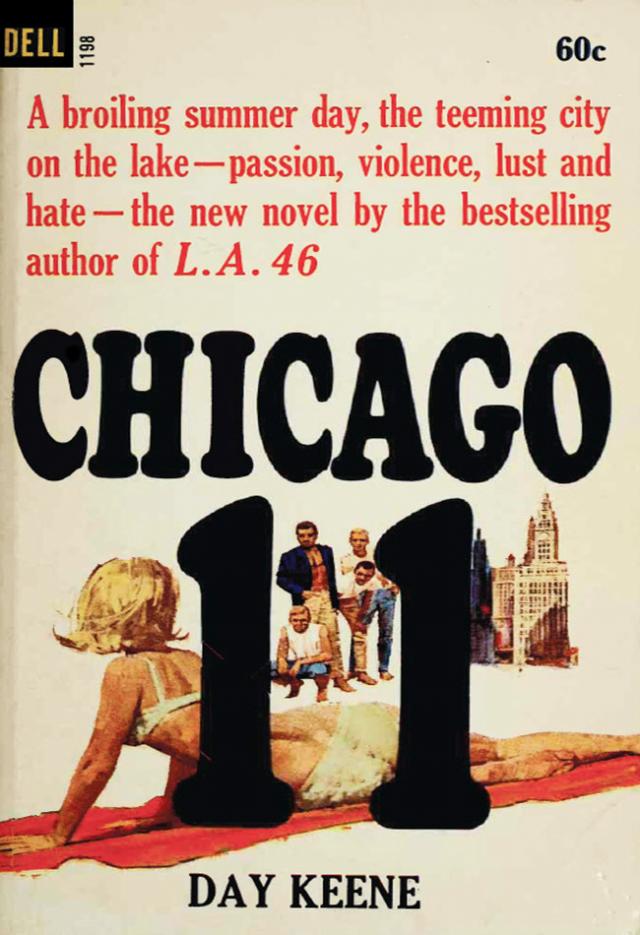
The way Frankie the Beard, Joe Joe, Harry and Solly figured it, the blonde owed them something. She managed to get away from them on the beach, but that wouldn’t happen again. Now they had the keys to her apartment . . . lots of ideas . . . and plenty of time.
When the door finally swung open, they were surprised to see a brunette—a shapely, real sweet innocent. She was only the next-door neighbor, but it was hot-as-hell outside and they’d been waiting a long time. An awfully long time. And with her just standing there in a negligee . . .
A CITY LIKE CHICAGO DOESN’T
SIZZLE IN THE SUMMER HEAT
—IT EXPLODES!
Queen and guttersnipe of cities, cynosure and cesspool of the world: Not if I had a hundred tongues, everyone shouting a different language in a different key, could I do justice to her splendid chaos. The most beautiful and the most squalid, girdled with a twofold zone of parks and slums; where the keen air from lake and prairie is ever in the nostrils and stench of foul smoke is never out of the throat; the great port a thousand miles from the sea; the great mart which gathers up with one hand the corn and cattle of the West and deals out from the other the merchandise of the East; widely and generously planned with streets of twenty miles in length, where it is not safe to walk at night; where women ride straddle wise and millionaires dine at midday on the Sabbath; the chosen seat of cut-throat commerce and munificent patronage of art; the most American of American cities and yet the most mongrel; the second American city on the Globe, the fifth German city, the third Swedish, the second Polish, with an Irish population second only to Boston; the first and only veritable Babel of the age; all of which twenty-five years ago was a heap of smoking ashes. Where in all the world can words be found for this miracle of paradox and incongruity? . . .
G. W. STEEVENS
British Tourist
June 4, 1896
BOOK ONE
CHAPTER 1
By the shore of Gitche Gurnee,
By the shining Big-Sea-Water,
At the door of his wigwam,
In the pleasant Summer morning,
Hiawatha stood and waited.
All the air was full of freshness,
All the earth was bright and joyous . . .
HENRY WADSWORTH LONGFELLOW
The Song of Hiawatha
It was the season for heat. The past few days had been warm. The last of the snow was melted. The lilac and the snowball bushes were in bloom. Sunday morning dawned hot and clear, with a soft breeze off the water helping to dilute, if not dispel, the reek of the spent gasoline fumes and other wastes being exuded from the metallic rivers of outbound cars flowing swiftly along the Outer Drive and the other networks of arterial highways transecting the onetime sparsely populated Ojibway Indian village on the south shore of Lake Michigan.
The building that was to play a large part in that day’s news was plainly visible to the occupants of the cars on the Outer Drive, although, dwarfed as it was by its background of the towering apartment buildings and hotels of Chicago’s Near North Side, it is doubtful that any of them noticed it.
The architecture was early Rhine, a form of self-aggrandizement made popular in the United States a few years before the era of the “Merry Widow Waltz” by the homesick brewers of Milwaukee who’d grown wealthy beyond their dreams of avarice on cheap labor and five-cent beer.
According to Miss Mary Daly, one of the three unmarried high-school teachers who shared a third-floor apartment in the building and who was writing a social history of Chicago as her thesis for a Ph.D., the structure had an interesting past. She claimed that the brownstone mansion, complete with turrets and balconies and minarets, with a three-story high octagonal entrance hall, was an exact duplicate of the lake-front Rhenish castle built in the eighties by the late Potter Palmer. The house, along with various ropes of pearls and diamonds and the Palmer House Hotel, was a wedding gift from him to his twenty-one-year-old bride.
As in the original, in its early days, a caller would be subjected to an unforgettable experience. After the calling card had been accepted by one of the butlers in residence, and passed down an assembly line of some twenty-odd footmen, maids and social secretaries, wonderful things happened. Depending on the reason for the call, the caller would be escorted into a French drawing room, a Spanish music room, an English dining room or down a Moorish corridor into a Turkish, a Greek or a Japanese parlor. Or, if the call happened to be of a more intimate nature, the caller was directed to one of the two private elevators and carried at the breathtaking speed of two miles an hour up to the huge master bedroom, where the first mistress of the house had composed herself for sleep, or for whatever activity she had in mind at the moment, in a gold cherub-encrusted Louis XV bed reputed to be ten feet high.
There had also been a grand ballroom, a formal banquet hall and a rooftop solarium.
According to Miss Daly’s research, the original builder had been one of the early hcg butchers, a multimillionaire, whose wife, of plebeian ancestry but with illusions of social grandeur, had thought that a proper setting for her charms and the musicales and soirees she meant to give would enable her to crash the sacrosanct preserves of the established local “Four Hundred.”
She was young and beautiful and gracious. She might have succeeded. Unfortunately, her husband, twice her age and desperately in love with her, wanted to adorn her person with more and more expensive gewgaws, so he’d forsaken the business he knew best for the perils of the stock market.
For a time he’d been very successful. He’d even been able to charter a private train to carry a party of friends to New York to attend the first automobile show in the United
States, which was staged in Madison Square Garden in the Year of Our Lord 1900. There, impressed by the noisy and horse-terrorizing machines which skilled chauffeurs raced around barrels and up ramps to the roof at the incredible speed of eight miles an hour, he’d purchased a phaeton, a Stanhope, a brougham and a Victoria to add to their growing menage on what was now being called the “Gold Coast.”
Then, on a day in May a short two years later, the former hog butcher was caught short in a squeeze play for control of the Northern Pacific. Having lost his entire fortune, he’d returned home for consolation and had gone up to his wife’s boudoir without using the regular channels. There he found her not only cognizant of the news but, clad only in a string of emeralds and lying on the gold-encrusted bed, she was consoling and being consoled by the equally nude and very handsome young chauffeur whom he’d imported to pilot his desolate wife’s Stanley Steamer.
Coming as it did so soon after the loss of his fortune, the social faux pas had been too great for the man to bear. So he forgot the amenities for the moment and made history by killing his wife and her lover with one well placed bullet from the Navy Colt he always carried with him before retiring to his mahogany-paneled study and putting a second shot through his own head.
Hundreds of other men had killed hundreds of other wives who’d been caught in flagrante delicto. But history had been made because it was the first time in Chicago that an outraged husband had killed a chauffeur. So when the tobacco-chewing coroner presiding over the inquest had rendered a verdict of “justifiable homicide of wife and chauffeur and suicide while of unsound mind,” he’d been obliged to ask one of the reporters present how to spell the then unfamiliar word.
Since that time the brownstone structure had led a varied existence. Even in those days of the robber barons, few men had been wealthy enough to maintain and staff such a structure as a private dwelling and the slowly aging mansion had passed through many hands.
It had been home to a wheat speculator and a Johnny-come-lately millionaire who’d made his money in real estate. It had been operated as a swank gambling casino, a boarding school for refined young ladies, a house for not so refined young ladies, and, during the early Prohibition years, as a society speakeasy.
However, with the growing conception that no matter how well it might pay, domestic service was menial, with the continuing trend toward coeducational institutions, with the fierce competition offered the professional filles de jole by the amateur lorettes who had entered the field, with the outlawing of even quasilegal gambling, and with the eventual return of the corner tavern, there’d come a time whe
For years, all through the Depression, it had stood neglected and forgotten by everyone but the tax collector. Then, shortly after the beginning of World War II, an enterprising real-estate developer, with an eye to future possible land value, had turned it into a taxpaying entity by the simple expedient of gutting the interior, replacing the archaic elevators with an ornate three-story spiral staircase and remodeling the brownstone shell into twelve, at the time very modem, one- and two-bedroom apartments.
The apartment rentals were high, but, because of their proximity to both the Loop and the Lake, they’d been in constant demand for years.
Now, unfortunately for the current tenants, and fortunately for the heirs of the entrepreneur who had remodeled the building and who had managed to maintain title, land values in the area had. risen so high that the occupants were under notice to vacate and. shortly after the first of July, the former private dwelling was scheduled to be demolished so that its relatively small ground site could become part of a twenty-four-story multimillion dollar ultramodern cooperative apartment complex.
CHAPTER 2
There was little pedestrian traffic on the street. As Mary Daly remembered, that was normal for a Sunday. This section of Chicago hadn’t changed. The only difference she noticed from the days when she’d been a girl was that there seemed to be fewer derelicts sleeping off their drunks of the night before in the dead-end areaways and debris-cluttered doorways of the closed business houses, occasional pawnshop, and cheap nightclub.
Of course, in those days she’d always been afraid one of the drunks might be her father.
The weatherman had been right. He’d said the Memorial Day weekend would be hot. Even this early in the morning it had to be close to ninety—with the worst heat of the day still to come.
She used a corner of the black lace mantilla covering her hair to pat at the film of perspiration on her cheeks. Instead of walking to Holy Name Cathedral, she should have driven. Better still, she should have gone to the Dunes with Ann and Cora.
The black-haired high-school teacher walked on down the semideserted street, the click of her high heels sounding unnaturally loud in the Sabbath silence. When she looked back on it, her early girlhood (at least all of it that she would allow herself to remember) had been strictly early James T. Farrell. A foul-mouthed Farrell addicted to four-letter words. In this section of Chicago, the section in which she’d been born, with its admixture of pimps and whores and drunks, cheap nightclubs, cheaper theatrical hotels, and grimy light-housekeeping rooms, the novelist’s southside Studs Lonigan would have been a bon vivant and the unsavory characters with whom he consorted the elite of the country-club set.
She could remember dressing for Mass and having her mother warn her, “And if you should happen to see your father on the way home, don’t even talk to the son of a bitch. We’re doing fine on relief. And when you finally finish Normal School and begin to teach and we move into that fine apartment we’re going to have, we don’t want any drunken old bum coming around begging a few dollars for a bottle and embarrassing us in front of our new neighbors.”
The light on the next comer was red. As Mary waited for it to change to permit the flow of nonexistent traffic, a middle-aged pedestrian coming along the side street paused to admire the lush body modestly sheathed in a becoming white dress,
“Hi,” he offered, tentatively.
“Drop dead,” the young woman said and returned to trying to equate her mother’s reasoning.
Even as a schoolgirl, she’d thought it rather ludicrous that her mother should feel the way she did about her father, setting herself up as his judge. This when she seldom went to Mass, never to Confession, drank as much, or more, than he did, and wasn’t above supplementing their relief check by accepting payment for favors received from the casual male friends she met in the bars along the street and allowed to accompany her home to whatever roach-infested rooms they happened to be occupying at the time.
Fortunately, if “fortunate” was the word, her father had died when she was fourteen and her mother two years later. She’d prayed for and said Rosaries for both, but, though it might be a mortal sin on her conscience, she hadn’t been able to cry on either occasion.
It could be Jim was right. It could be something was missing in her emotional and biological make-up.
“You’re cold,” the psychology teacher had accused her. I don’t believe you’re capable of love. All you really give a good goddamn about is your job and those frigging degrees you’re always working toward.”
All this because she had refused to accompany him to a resort on Eagle River where he had hoped to enjoy a pleasant weekend having prenuptial relations with her.
Mary walked on through the heat. However, she didn’t think she was cold. At least she hoped she wasn’t. One corner of her mouth tugged down in a wry smile. She knew she was capable of love. She loved God. She loved Jesus. She loved the Sister of Mercy who had taken her in after her mother had died and had made certain that she finished her education.
And when the right man came along, she could love him. Any way he wanted her to love him. Her former fiancé would never know how close he’d come to his goal. If instead of quarreling with her he’d kept on kissing her, or had gotten his hand a half inch higher, anything could have happened. She still didn’t know why it hadn’t.
But facts were facts. She was twenty-six years old. She would be twenty-seven in September, and she had broken up with the only man to whom she’d ever been engaged. It could be she’d wind up an old maid. Any number of teachers did.
When she came to the cross street on which she lived and turned east, she was rewarded by a relatively cool breeze blowing in off the lake.
Normally she attended St. Agnes. But that morning, because both Ann and Cora were out of town and she’d reached that part in her thesis covering the social mores of an era that had ended before she was born, she’d walked the additional blocks to Holy Name Cathedral.
Her research sources had been correct. There were chips in the granite facade of Holy Name Cathedral. Nor had she any reason to doubt they had been made by the machine-gun bullets that had ended the career of one Earl Wajcieochowski, better known in the gangland circles of his day as Hymie Weiss. It should make an interesting chapter. Both Hymie and the man he’d succeeded, a onetime choir boy named Dion O’Banion, had, in their own way, been fabulous characters.
According to the research she’d done for her doctorate in sociology, O’Banion had been a swashbuckling, flower-loving, cheerful murderer who had always carried three pistols in the special pockets sewn into his custom-tailored suits and who was alleged to have killed, or have ordered killed, at least twenty-five men. As a boy he’d sung in the choir of Holy Name Cathedral. As a man he had banked a million dollars a year from his traffic in bootleg whiskey, plus the considerable profits from the flower shop he’d operated at 738 North State Street as a cover for his illicit activities. That is, he had banked a million dollars a year until he had quarreled over a division of spoils with the Union Siciliana-dominated Johnny Torrio-Al Capone combine.
It was shortly after that when O’Banion, alone in his flower shop except for a Negro porter, had heard the front doorbell tinkle. Tenderly, almost lovingly clipping the stems from a bouquet of white chrysanthemums, he had emerged from his workshop to greet three strangers whom he’d had every reason to believe were calling for one of the floral works of art for which he was justly famous.
It had been a fatal assumption.
Later, Weiss was to claim that the killing had been planned by Torrio and Capone, but the police had never been able to obtain sufficient evidence to justify an arrest. All that was known for certain was that, when the three men left the flower shop, O’Banion was dead.






