Ukulele of death, p.1
Ukulele of Death, page 1


Contents
Cover
Also by E.J. Copperman
Title Page
Copyright
Dedication
Author’s Notes
Chapter One
Chapter Two
Chapter Three
Chapter Four
Chapter Five
Chapter Six
Chapter Seven
Chapter Eight
Chapter Nine
Chapter Ten
Chapter Eleven
Chapter Twelve
Chapter Thirteen
Chapter Fourteen
Chapter Fifteen
Chapter Sixteen
Chapter Seventeen
Chapter Eighteen
Chapter Nineteen
Chapter Twenty
Chapter Twenty-One
Chapter Twenty-Two
Chapter Twenty-Three
Chapter Twenty-Four
Chapter Twenty-Five
Chapter Twenty-Six
Chapter Twenty-Seven
Chapter Twenty-Eight
Chapter Twenty-Nine
Chapter Thirty
Chapter Thirty-One
Chapter Thirty-Two
Chapter Thirty-Three
Chapter Thirty-Four
Chapter Thirty-Five
Chapter Thirty-Six
Chapter Thirty-Seven
Also by E.J. Copperman
Jersey Girl Legal mysteries
INHERIT THE SHOES *
JUDGMENT AT SANTA MONICA *
WITNESS FOR THE PERSECUTION *
AND JUSTICE FOR MALL *
Haunted Guesthouse mysteries
NIGHT OF THE LIVING DEED
AN UNINVITED GHOST
OLD HAUNTS
CHANCE OF A GHOST
THE THRILL OF THE HAUNT
INSPECTOR SPECTER
GHOST IN THE WIND
SPOUSE ON HAUNTED HILL
THE HOSTESS WITH THE GHOSTESS
BONES BEHIND THE WHEEL
Asperger’s mysteries (with Jeff Cohen)
THE QUESTION OF THE MISSING HEAD
THE QUESTION OF THE UNFAMILIAR HUSBAND
THE QUESTION OF THE FELONIOUS FRIEND
THE QUESTION OF THE ABSENTEE FATHER
THE QUESTION OF THE DEAD MISTRESS
Mysterious Detective mysteries
WRITTEN OFF
EDITED OUT
Agent to the Paws mysteries
DOG DISH OF DOOM
BIRD, BATH, AND BEYOND
* available from Severn House
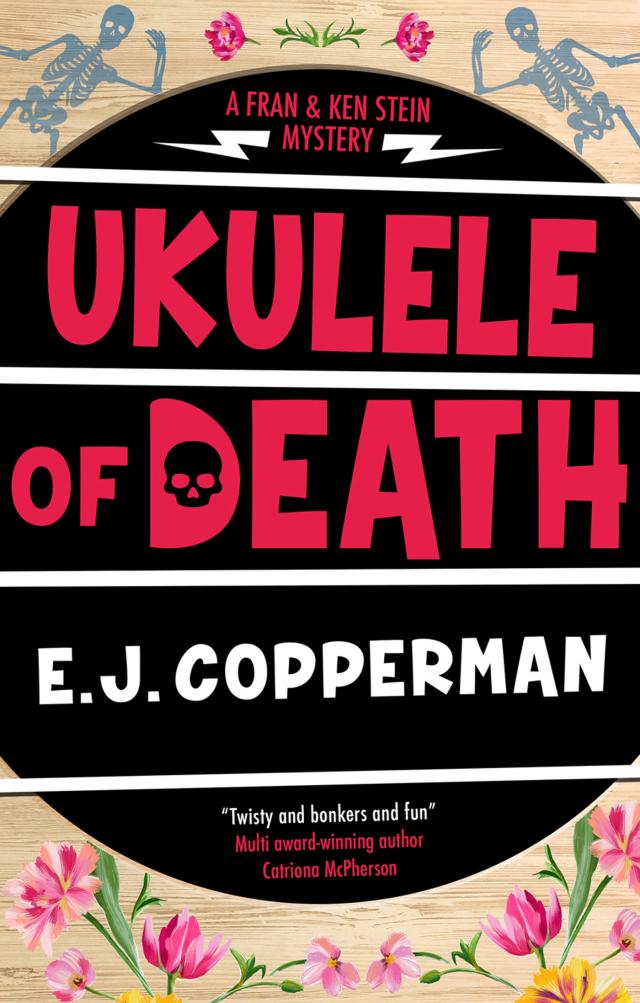
UKULELE OF DEATH
E.J. Copperman
This ebook is copyright material and must not be copied, reproduced, transferred, distributed, leased, licensed or publicly performed or used in any way except as specifically permitted in writing by the publishers, as allowed under the terms and conditions under which it was purchased or as strictly permitted by applicable copyright law. Any unauthorised distribution or use of this text may be a direct infringement of the author’s and publisher’s rights and those responsible may be liable in law accordingly.
First world edition published in Great Britain and the USA in 2023
by Severn House, an imprint of Canongate Books Ltd,
14 High Street, Edinburgh EH1 1TE.
Trade paperback edition first published in Great Britain and the USA in 2023
by Severn House, an imprint of Canongate Books Ltd.
This eBook edition first published in 2023 by Severn House,
an imprint of Canongate Books Ltd.
severnhouse.com
Copyright © E.J. Copperman, 2023
All rights reserved including the right of reproduction in whole or in part in any form. The right of E.J. Copperman to be identified as the author of this work has been asserted in accordance with the Copyright, Designs & Patents Act 1988.
British Library Cataloguing-in-Publication Data
A CIP catalogue record for this title is available from the British Library.
ISBN-13: 978-1-4483-0970-2 (cased)
ISBN-13: 978-1-4483-1049-4 (e-book)
This is a work of fiction. Names, characters, places and incidents are either the product of the author’s imagination or are used fictitiously. Except where actual historical events and characters are being described for the storyline of this novel, all situations in this publication are fictitious and any resemblance to actual persons, living or dead, business establishments, events or locales is purely coincidental.
This eBook produced by
Palimpsest Book Production Limited,
Falkirk, Stirlingshire, Scotland
For everyone who ever felt … different.
And with apologies to Mary Wollstonecraft Shelley.
AUTHOR’S NOTES
This is – get ready – my 30th published novel. That wipes me out every time I consider it. Your mileage may vary.
It’s been a long and twisty road. From the first three Aaron Tucker books from Bancroft Press through Elliot Freed and his movie theater, the Haunted Guesthouse series, the detours of Duffy Madison and Rachel Goldman (with her menagerie) to our own Sandy Moss and entourage, I’ve never known what was next and I still don’t. I sort of like it that way.
But given that this is a chance to look back, let’s go all the way back. Thank you to Bruce Bortz for making me a published author 21 years ago. Thanks of course to Shannon Jamieson Vazquez for reading NIGHT OF THE LIVING DEED and telling Berkley it should be a series (and for teaching me how to really write a novel). Thank you to Christina Hogrebe for getting that book to Shannon.
Thank you to Crooked Lane for picking up the Guesthouse series for two extra novels and for launching Duffy, even if he didn’t get very far. And to Marsha Markham for listening to a one-sentence pitch for the Agent to the Paws series and saying, “Sold.”
But let’s get back to the present. Sandy Moss exists and continues because of the fine people at Severn House, chiefly Rachel Slatter and Kate Lyall Grant. Sandy had been waiting a while to tell her story, but they loved it and decided you might enjoy it too.
And Rachel also liked meeting Fran and Ken Stein, and that’s why you’re reading this book. Sure it’s weirder than usual, but Rachel saw the humanity in these almost-humans and laughed, turned pages and got this story to you. I hope it’s everything she thought it might be.
The hero of the story, as ever, is Josh Getzler and all at HG Literary. Josh brings me down off the ledge when I’m sure I’ll never sell a book ever again and encourages my personal strangeness that led to Fran and Ken.
The people who most keep this author sane (if you use that word in a flexible manner) are Jessica, Josh and Eve. They are invaluable, which given the odd language we use, means really valuable. They are my real world. The one in my head has people like Fran and Ken, and they’re lovely, but high-maintenance.
The most heartfelt thanks are for all the booksellers, librarians and (especially) readers. Without you I’m some bizarre human ranting about imaginary people. Never feel like you’re not valued.
It’s been a crazy first 30 books, but I think I’m starting to get good at this.
E.J. Copperman
Deepest New Jersey
November, 2022
ONE
When Evelyn Bannister first asked me to find her ukulele, I thought she was kidding.
I realize that our economic times are not fabulous, and a working private investigator should probably take any job that’s offered, but it was hard to believe that Evelyn, who was tall, tailored, and trim, would need a detective to find a small Hawaiian stringed instrument.
‘You want us to find what?’ I asked. Clearly I’d misheard her and now she would make her request more clear.
‘A ukulele, Ms Stein,’ Evelyn insisted, looking me straight in the eye, which was possible only because we were both seated. Evelyn was tall; I was really tall. There’s a difference. ‘It’s very rare and quite valuable, but that’s not why I’m interested in finding it.’
‘You realize that our specialty is helping people find their birth parents,’ I reminded her. It’s not the only thing we do, but it is what we do most often.
Evelyn nodded. ‘And that’s why I came here. I think the uke might be the key to finding my father.’
Ooooookaaaay … Actually, I’d heard weirder stories before. I couldn’t think of one at the moment (aside from my own), but I was sure I had. ‘How’s that?’ I asked in my best business voice.
My brother Ken and I had opened K&F Stein Investigations after I’d received my master’s degree in criminal justice from Fordham University. It wasn’t that I couldn’t find a job with a city, state, or federal agency – I’d had offers – it was more that I wanted to help people like us who had never met their birth parents. Ken and I technically never would, but I’ll get to that shortly.
Ken had been working on the docks at Port Elizabeth in New Jersey, exercising his absurdly strong body and putting his mind on hold. My brother is a wildly handsome, brawny man, and at the age of twenty-six, was more interested in letting women discover that than planning a serious career for himself, so I took it upon myself to create one for him.
‘I’m opening a detective agency, and I need someone who can back me up if things get physical,’ I’d told him one night at the apartment he was sharing with two other guys and one very open-minded girl near the South Street Seaport.
Ken looked me up and down and let out a sound like pfff. ‘Dude,’ he said, despite the fact that I’m not one, â €˜I’m pretty sure you can take care of yourself.’
I couldn’t really argue that point; besides being unusually tall and a little muscular for a woman, I was also trained in three martial arts, and was a black belt in two. I’d never been in a situation in which I’d felt the slightest bit physically threatened, at least not since the fifth grade, when a high-school kid tried to take my friend Patty’s bike and I’d left him panting on the sidewalk saying something like – no, on second thought, saying something exactly like – ‘Please just don’t hurt me. Please.’
‘I can, but there’s only one of me,’ I said to Ken now. ‘Besides, do you want to unload ships for the rest of your life? Here’s a chance to be partners in a business. You get half the profits.’
‘Or half the losses when the place goes belly up,’ Ken said, opening a beer from the third-hand refrigerator. ‘You’ve never run a detective agency. What do you know about it?’
‘I know how to do research, I understand the legal system, and I’m tied into some government databases through friends I met during the program,’ I told him. ‘I know how it feels to be left on your own and not know who your family is. I know the nagging questions that come with parents who aren’t there when you’re growing up. And I know about office space I can get really cheap on 25th Street over a Jewish deli.’
Ken plopped himself down on a sofa that, once he’d landed on it, looked like a child’s armchair. He took a long pull on his beer, so long in fact that it was empty before he spoke again. ‘I wouldn’t mind coming home at night and not smelling like Port Elizabeth,’ he said. Ken’s also a deep thinker. It’s not that he’s unintelligent – he’s actually very smart – but he’s, let’s say, intellectually lazy. If there’s a game, any game, on TV or a certain type of woman (breathing) nearby, he can be a little distracted.
‘Right. You’d be here in Manhattan, you’d be a full partner, and you’d be doing work that will help people like us.’
His eyes focused sharply on me. ‘There are no people like us,’ he reminded me.
I tilted my head to the right to concede the point. ‘People who have concerns similar to ours,’ I corrected. Ken nodded, allowing me the distinction. ‘And it’ll only cost you a few thousand dollars to buy in.’ I stood up, reaching out my hand for him to shake in agreement.
But I hadn’t slipped that last point in sneakily enough; Ken sputtered and sat up with a jolt. ‘A few thousand to what?’ he asked. ‘I’ve got to put up money for this wacky idea of yours?’
‘I’m doing it too,’ I pointed out. ‘But I’m a little short on operating capital, and it’s just while we get started.’
‘Frannie,’ my brother said, ‘you have a way of only telling me the part of the story you think I want to hear.’ His eyes narrowed. ‘How much?’
There was no point in being coy. ‘About eleven thousand. That’s the security deposit on the office space, some furniture and a receptionist for a month.’
‘Eleven grand!’ Ken huffed. ‘What are you putting in?’
‘I’m still paying off student loans, Ken. I haven’t been working for three years like you.’
He cocked his left eyebrow. ‘So you’re putting in nothing.’
I’ll admit it – I avoided his glance. ‘I wouldn’t call it nothing,’ I said. ‘I’m paying for the first shipment of office supplies and having the place painted.’ The landlord was having the place painted for nothing, but Ken didn’t need to know that.
‘So you need me for muscle and money,’ Ken said, grinning. ‘Not to mention negotiating advice, because the landlord should be paying to have the space painted.’ Touché.
I put my hand on my hip. ‘Are you in, or not?’
His grin got broader. ‘What do you think?’ he asked.
Evelyn Bannister nodded her understanding at my confusion. ‘The ukulele in question is a Gibson Poinsettia, with hand-painted flowers and fret markers. It’s quite rare and sought after by collectors.’
‘How much is it worth?’ I asked.
Evelyn seemed surprised by the question. ‘I haven’t the faintest idea,’ she said.
‘But you think somehow it can lead to your birth father?’ I asked, trying to get some idea of the relevance of a small Hawaiian guitar to my job. ‘You are adopted?’
She nodded. ‘Bannister is the name of my adoptive parents, and they’re the ones I’ve always known. It’s really a question of curiosity for me.’
I was taking notes on my laptop. ‘Why just your father?’ I asked. ‘Do you have some knowledge of your birth mother?’
‘Yes,’ Evelyn answered, her hand lightly grazing her forehead. It wasn’t hot in the office, but Evelyn appeared to be a little damp around the hairline. I reached over and turned on a small electric fan positioned on a file cabinet. It’s a classy operation I run. ‘I met her last year, after I contacted the agency through which I was adopted. Her name is Melinda Cantone, and she lives in Bethesda, Maryland. She agreed to meet with me, but only in public, so I don’t have her address.’ Evelyn slid a file, which she dug out of a Louis Vuitton tote bag, across the desk to me. The vacillating fan made the cover of the file flutter a bit, and then vacillated out of position, and the cover lay down again.
‘But your father was not willing to allow contact, is that it?’ It’s not unusual for birth parents to move on and not want to reconsider their choice to part with a child. Most of them are very young when they put the baby up for adoption. It’s never an easy decision.
‘That’s right,’ Evelyn answered. ‘But I have questions I need answered, and he’s the only one who can tell me. Will you help?’
‘At this point, I need to find out if we can help before I can say if we will,’ I told her. It’s best to keep expectations realistic, especially when you don’t know what you’re talking about. ‘Now, what do you know about your biological father?’
Evelyn seemed like she was concentrating very hard on her answer; her eyes narrowed to slits and her lips pursed just a little as she thought. ‘The adoption agency wouldn’t tell me much. You know, you can’t even get a name when the parent doesn’t consent. But my birth mother told me they never married. They were just a high-school thing.’
‘And she wouldn’t tell you his name, either,’ I guessed.
‘No. She said it was his choice. But she did tell me that he had moved out of Nashua, New Hampshire and made a lot of money here in New York on the stock exchange. Not like a billionaire or anything, but he’s apparently quite wealthy.’ Her long, elegant fingers seemed nervous; she had folded her hands but her fingers were fluttering.
‘What’s this ukulele thing all about?’ I asked. ‘Why is that a clue to your birth father’s whereabouts?’
‘Apparently he is a collector of rare stringed instruments. He has a guitar that once belonged to George Harrison and a harp that was played in a movie called Duck Soup by Harpo Marx.’ Evelyn said ‘Harpo Marx’ like you’d say an unpronounceable name in another language. ‘This ukulele, being so rare, was once in his possession. If you find it, perhaps you can trace it to its previous owners. Find the one who used to live in Nashua, and you’ll find my birth father.’ (For the record, there would be virtually no way to trace previous owners of an instrument, but there were other ways to track down where it might have been, starting with where it was right now. Whoever sold it this time would know where they had acquired the uke, and so on. It wasn’t much, but it was something.)
I’ve worked on cases that were bigger leaps of logic, but not many. How many George Harrison guitars or Harpo Marx harps could there be? (Probably a decent number, actually.) Now was the time in the client intake interview where I perform a ritual: I take off my glasses (which are mostly for show, anyway – I see just fine, but people think you’re smarter if you wear glasses), put down my pen, and look into the potential client’s eyes with great meaning.
‘Are you sure you want to meet a parent who has chosen not to meet you?’ I asked Evelyn. ‘You could be setting yourself up for a painful rejection.’
‘I’ve thought about it a long time, Ms Stein,’ she answered in a voice that had no waver to it. I pay attention to that. ‘There are too many things I don’t know. Medical histories, geographical origins, personality traits that might have been passed down. I don’t need to jump into his lap and call him “Daddy.” I have a father, and he’s terrific. He just happens to not be my biological parent. That’s OK. But I do want to look my birth father in the face and have a conversation. That’s all.’