Binary system, p.3
Binary System, page 3


The caravan of spider-crabs came to a halt a hundred metres from the life-raft. Delia stared out, her stomach tight with apprehension.
As she watched, the insect riders on the first spider-crab dismounted, and Delia gasped in astonishment.
One second, the locusts were seated one behind the other on their mount – and the next they were standing on the ice beside one of its great hairy forelegs. There had been no noticeable transition. They had moved so fast that it was as if the creatures had teleported themselves from the back of the spider-crab.
A heartbeat later they had crossed the intervening hundred metres and were standing very still and staring at the life-raft. This time, Delia had detected a blur of movement, a sheen of silver-grey as the locusts moved, lightning-fast, across the ice.
Involuntarily, she took a step back from the viewscreen, although she knew the aliens could not see through the wall of the craft.
Behind the first six locusts, more of them dismounted, vanishing instantly from atop their mounts and appearing beside their compatriots, their long heads and bulging, microphone eyes directed at the life-raft.
Delia took a step forward to better examine the aliens.
Their arms and legs were long and perilously thin, osseous spars jutting from skeletal shoulders and concave pelvic flanges. They looked as if a light tap might send them skittling.
Their heads moved from side to side as they examined the shell of the vessel, their mandibles opening and shutting in silence.
She turned in alarm as something clanged against the side of the life-raft. A vibration conducted itself through the carapace.
What...?
I think they are cutting their way into the life-raft, Delia. Activate your thermal suit and pull on the face-mask.
Delia did as instructed and turned to the source of the noise. Something appeared through a slit in the padding of the life-raft’s ceiling, a hooked blade that slowly worked its way down the curving bulkhead like an antique can-opener.
I should be able to see the funny side of this, Imp, she said. But to be honest...
Remember, do nothing that might be perceived as a threat. I suggest that they will be as fearful of you as you are of them. You are, after all, a member of a technologically superior race, going on what I have observed to date.
She was heating up in the thermal suit. A wind like a razor blade slashed through the gap, freezing her hands. The sleeves of her suit incorporated gloves, and she lost no time in pulling the material over her hands.
The blade had reached the extent of its vertical incision. It withdrew, to appear a moment later at the top of the slash, cutting horizontally.
Delia glanced at the viewscreen, but all the aliens had moved around the raft to view the opening.
The blade was now slicing another vertical gash in the wall. She expected them to make another lateral cut at the bottom, forming a square, and stood back to avoid the section of the wall falling in upon her, but they took another approach.
As she watched, the flange of metal bowed inwards – pressed downwards, she saw, by the great hirsute foreleg of one of the spider-crabs. A freezing wind filled the raft, and despite her thermal suit Delia shivered. When the flap of metal was folded down all the way to form an ad hoc ramp, the monstrous leg was withdrawn.
A dozen insect heads appeared around the edge of the gap, staring in at her. She stood erect, matching their inscrutable gazes.
She wondered what they made of her, this puny scrap of humanity cast up so far away from home.
Four aliens were beside her in the life-raft. She didn’t see them enter; they simply winked into existence at her side.
She backed away.
Their long heads jutted forward, moving from side to side as they examined her, their mandibles clacking like a cacophony of castanets.
Remain calm, Delia, her Imp counselled. They have shown, so far, no inclination towards hostility.
She saw a flicker of movement to her right as one of the aliens plucked the charger from her hip pocket. The creature passed the silver disc to its neighbour, who held it at arm’s length, as if testing whether or not it might be a weapon. Another alien took the charger, turning it over and over. They looked at each other, jaws working.
Delia watched them, willing them to replace the charger in her pocket.
She should be so lucky. The alien to her right completed its examination of the device, then dropped it to the floor.
Before she could work out how to retrieve the charger, she felt something wrap itself tightly around her arms, legs and torso. She was bound by a tight silver thread, and it was all she could do to remain on her feet.
Then she was borne aloft and carried at incredible speed from the life-raft and across the ice. She felt claws digging painfully into her arms and legs.
The charger, she thought...
Remain calm, her Imp said. Don’t struggle. They have shown no desire to do you harm.
Yet, she said.
It is my assessment that they are more curious than hostile.
She was carried at dizzying speed across the ice towards one of the huge spider-crabs, everything a blur around her. Her vision adjusted as she was lifted up onto the back of the creature. Two aliens tied her, again with loops of silver thread, to the dome of the spider-crab’s body above its antennae’d head. To either side of her, a forest of thick black hairs sprouted from osseous follicles. She was joined by two guards who settled themselves beside her, their femurs folding up alongside them. Another alien climbed onto the creature’s head and gripped its antennae.
The spider-crab moved, and Delia felt a plate of chitin shift beneath her. To her right and left, the spider’s great legs rose and fell like pistons.
She looked down and saw her life-raft. A group of aliens was attaching thick silver ropes to the vessel and slinging them around the haunches of one of the spider-crabs. The creature took the strain and the life-raft moved across the ice like a sled. She thought of the charger on the floor of the raft, and wondered at the chances of her getting it back again. At least they weren’t leaving the life-raft out on the plain.
The procession moved across the ice, heading in the direction of the distant mountains.
Where was she being taken?
She sub-vocced the question to her Imp.
No doubt to the nearest extraterrestrial city, it replied. Remain calm.
She smiled. There’s little else I cando.
You are warm enough?
Toasty, thank you.
I think it would be wise to sedate you, until journey’s end.
Very well, but I don’t want to miss anything. Wake me if anything interesting happens.
Imp released sedative into her system, and Delia slipped into unconsciousness.
Chapter Five
SHE WOKE FROM a dream of dining with Timothy in Paris.
The reality of where she was and what had happened came crashing down on her. The dream I had been enjoying should be the reality, she told herself – and this the dream... or nightmare.
They were no longer on the ice plain.
From her position above the head of the spider-crab, Delia looked across a vista of folded foothills, falling away like buckled steel, scintillating with silver frost. She turned her head to look to the rear; hers was the leading beast. A dozen more followed slowly along a narrow road that climbed into the mountains. The same mountains, she realised, that she had seen on the distant horizon.
Imp, how long have I been out?
Almost one day, Terran, Delia.
One day...
How long does a day last on this world?
Approximately twenty Terran hours.
The guards crouched on either side of her, their bulging eyes staring ahead at the falling foothills. Four other aliens squatted behind her on the dome of the spider-crab’s body.
From time to time the guards conversed in an incomprehensible rattle of mandibles.
She had a thought.
Imp, can you translate what they’re saying?
For the past twenty-four hours, since our capture, I have been running a logic analysis on their language. I estimate that I might have a rudimentary understanding of their spoken language within six hours.
She looked ahead, up the winding length of the road into the mountains. She made out rearing silver peaks, more attenuated and spire-like than natural rock formations on Earth. It was as if they were sculpted, joined one to the other by scooped ice walls. Above the peaks the great red sun bathed the scene in its bloody light.
Imp, are we heading into winter or towards summer?
The planet is moving towards its primary, Delia. I calculate that in approximately one Terran week, a great thaw will take hold of the planet, presaging the brief summer.
Things must change dramatically, she said.
The ice will vanish, the landscape will be reformed. I suspect that dormant seeds will take advantage of the sunlight and bloom, briefly, before dying back as another long, hostile winter commences.
What a world... and yet sentient life has evolved.
Life that has adapted itself to extremes of great cold and punishing heat.
Timothy could only have dreamed of experiencing this world. As a xeno-biologist, he would have found the strange, inimical planet fascinating, a case study that would have occupied him for years.
She shut her mind to Timothy and his fate and concentrated on the here and now.
Imp?
Yes.
Even if I survive, if I’m allowed my freedom by these... these creatures... even then, what are the chances of my ever leaving this world – of getting back to Earth?
The reply was what she expected: consoling, avuncular, wise. We are in no position to make such evaluations at present, Delia. We are not in full possession of all the facts. In time, maybe, when we have assessed the level of technology possessed by the extraterrestrials, then we might be able to determine our chances of escape. Until then I counsel calm, caution, and vigilance.
The road ahead turned around a projecting knuckle of ice-covered rock, and an archway through a wall of ice hove into view. The caravan of spider-crabs plodded on. Delia was lulled by the back and forth motion of the great beast. She was warm in her thermal suit, and she guessed that her Imp was releasing tiny quantities of sedative into her system. By all that was right and proper, she should be grieving her lover, and her homeworld. Instead she felt only a dull fear, tempered by curiosity
But if she could not retrieve the charger, then in time she would be without Imp.
The thought roused her and she said, Imp.
Delia?
I can’t recall... when was the last time I used the charger, back on Earth?
Almost twenty days ago.
She felt a pit of despair open up within her. But that means in ten days...
Be calm. Don’t dwell on eventualities that might never occur. Ten days is, after all, a long time. I will work to retrieve the charger.
She nodded. Thank you, Imp.
Chapter Six
FIVE HOURS LATER they left the plain of ice in their wake and took a track that wound further into the foothills, and an hour after that they rounded a pinnacle of rock and came upon a remarkable sight.
It’s... it’s beautiful.
The mountain fastness of the natives, Imp said.
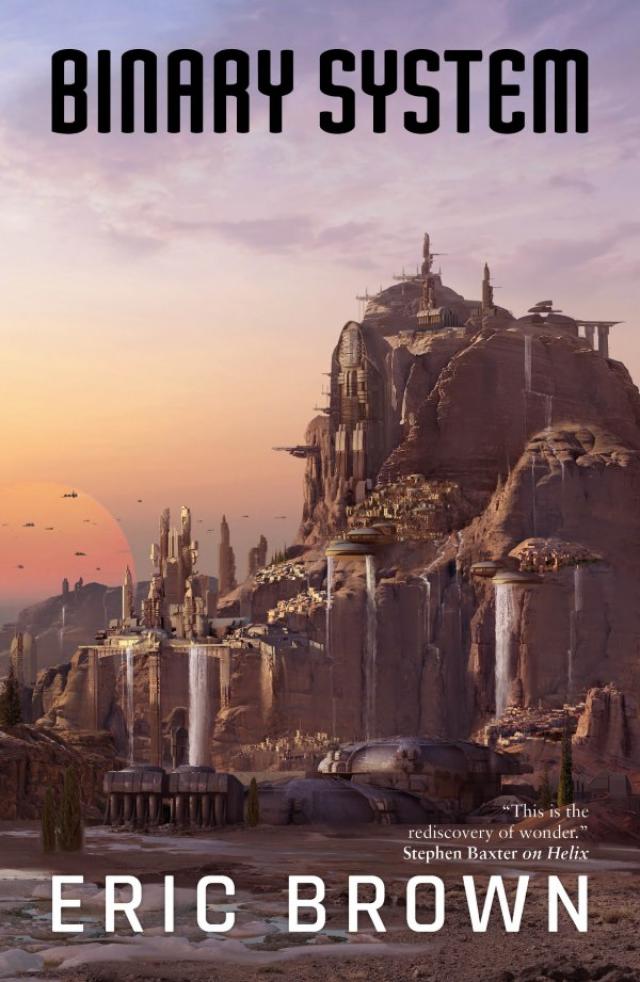
On the far side of a yawning chasm, which she guessed was a kilometre or two wide, was an ethereal city of spires that mimicked the soaring peaks strung out to either side. The towering buildings, accessed by broad sweeping steps and cantilevered walkways, glowed in the bloody light of the sun. She looked for any sign of mechanised traffic, but saw none, and this absence lent the city a quietude that matched its grandeur.
The high, narrow road curved around the chasm to the city. A keening wind whistled through the peaks; Delia was grateful for her thermal suit.
She wondered what awaited her in the city of the locusts.
Imp, have you managed to work out their language yet?
I am working on it.
How long until...?
Soon, now.
The caravan clanked along the roadway around the chasm. They passed from the shade and Delia felt the warmth of the sun on her head. Halfway along the great curving roadway, she looked back and saw the last spider-crab, hauling her life-raft. The vessel filled the width of the road, and the locusts in charge of the creature were urging it forward little by little.
She looked away, fearing it might slip into the chasm and be lost forever, the precious charger with it.
Seconds later the locust mounted on the headpiece of her spider-crab pulled on its antennae and brought the beast to a halt. The guards became excited; they chattered to each other, then called out in a string of clacking, ringing notes to the steersman.
She became aware of a sweet, acrid stench, faint at first but growing stronger. She heard shouted commands along the length of the caravan. The alien to her right prodded her, and pointed into the chasm. They evidently wanted her to take note of something.
What is it? she asked her Imp.
It appears to be some form of graveyard. Look...
The stench rising from the chasm made her gag, even through the facemask.
She peered down.
The vast oval of the chasm was half-filled with what looked like discarded sections of sable chitin, great cowls and domes of shell stretching away to form an oddly beautiful osseous landscape. Here and there, blackened body-parts protruded through the chitin and high into the air, stark shanks and vaulting ribcages. Nearby a timber jetty extended into the chasm, raised on pillars above the sea of bones.
As she watched, a spider-crab was removed from the caravan by its erstwhile riders and goaded along the jetty. The creature, perhaps sensing its fate, appeared reluctant to advance; the locusts prodded it with staffs, working them into the gaps between its jointed legs and twisting savagely.
What are they doing?
The question was rhetorical, but her Imp answered anyway. It would appear that this is some form of sacrifice, perhaps a ritual appeasement or offering.
She glanced at her guards, and at the other aliens mounted on the spider-crabs. All were silent, intent on what was taking place on the jetty as the hapless creature was goaded forward little by little.
Then the dozen aliens drew long, scimitar-shaped swords from scabbards and proceeded to rend the spider-crab limb from limb. The locusts moved in a blur; Delia watched in appalled fascination, seeing not the movement of the beast’s tormentors but the effects of their handiwork as limbs appeared to fall away, one by one, by their own volition. The air was rent with high-pitched squeals as the beast tottered on its remaining limbs.
The creature toppled and hit the timbers with a crack, a limbless torso leaking ichor across the boards of the pier, its severed limbs scattered like so many jackstraws.
A great clacking cheer went up from the gallery of watching aliens, and the creature’s executioners proceeded to discard the limbs and eye-stalks from the pier, the body parts rattling down into the grave pit.
Then, working in concert, the locusts heaved the dripping body and tipped it into the chasm. It fell in a spray of ejected body fluid and hit the sea of shell-fragments with a ripe, cartilaginous crack.
Delia glanced at her guards; their mandibles moved, but in silence, and she wondered if they were intoning silent prayers to whatever alien god they worshipped.
The caravan started up again and they proceeded along the roadway to the city.
They’re savages! she said.
It would be a mistake to fall back on anthropocentric prejudices when considering an alien race, Delia. They might be a highly civilised, learned people, for all we know, with abstruse philosophies and strict moral and ethical codes. None of that would be inconsistent with what he have observed.
You’re right, she allowed, but even so...
She stared ahead at the city rising from the escarpment. The soaring towers and minarets were ethereal, and so bright that she thought, at first, that they had been carved from ice. The caravan approached the city and proceeded along a wide boulevard. The buildings on either side were fashioned from scintillating stone, long blocks placed end to end, with high, narrow openings – windows and doors – carved with fluted embrasures and arches.
The most striking thing about the city, she noted, was that it appeared entirely deserted. Not a single citizen moved along the boulevard or the narrow alleys running off it between the towering minarets. An eerie silence prevailed, broken only by the sound of the spider-crabs’ ringing footfalls on the vast slabbed paving of the boulevard.
They passed between two high buildings, as grand as Terran cathedrals, and came into a great square – and here at last Delia saw movement.
She blinked in surprise at the figures gathered at the far end of the square. They were not the locust creatures, but small beings which resembled thin, long-limbed Terran apes, though with fur coloured a striking iridescent blue.
A hundred of the creatures hauled slabs of stone across the square; others worked on the stones with chisels and saws.
As the caravan emerged from between the buildings, the blue creatures ceased work and stared across the square.
Delia said, awed, Another sentient race?
So it would appear... Though the probability of two sentient species emerging on a single planet is very low, based on current evolutionary models.
They can’t be related, the locust and these... these primates?
Obviously not. A client species, or...
Yes?
Or a slave species.
They left the square and passed down an alley between tall buildings, entering cold shadow. She made out an archway ahead, hewn from natural rock. The steersman of her spider-crab urged it on, ducking when they came to the arch. They passed into a tunnel and Delia pitched forward against the ties that bound her as they began to descend.
Darkness fell, alleviated once in a while by flaming sconces set into the wall. She made out chiselled stone, occasional branching passageways.