The book haters book clu.., p.1
The Book Haters' Book Club, page 1


Praise for the novels of Gretchen Anthony
“This sparkling novel starts with high energy and unique characters that move from one surprise to another.”
—Ann Garvin, USA TODAY bestselling author
“Moving, humorous, and briskly-paced, The Kids Are Gonna Ask is a pure portrait of Minnesota nice, filled with empathy, wisdom, and characters you’ll love to root for.”
—J. Ryan Stradal, New York Times bestselling author of
Kitchens of the Great Midwest
“The Kids Are Gonna Ask is a touching, wonderful novel about the discoveries we make when the simplest questions spark the most complicated answers.”
—Abbi Waxman, bestselling author of The Bookish Life of Nina Hill
“The Kids Are Gonna Ask is a smart, engaging send-up of our modern age wrapped up in a story too delicious to put down.”
—Kelly Harms, bestselling author of The Overdue Life of Amy Byler
“Anthony’s debut successfully mixes realistic emotional responses to big life events with a sense of humor, preventing any single character from becoming a victim or a villain.”
—Library Journal, starred review
“Evergreen Tidings from the Baumgartners hits all the right notes; you’ll double over with laughter, but you’ll also find yourself at times misty-eyed and introspective.”
—Kristin Harmel, bestselling author of The Life Intended
GRETCHEN ANTHONY is the author of Evergreen Tidings from the Baumgartners and The Kids Are Gonna Ask, winner of the 2021 Alex Award from the American Library Association. Her work has been featured in the Washington Post, Medium and The Write Life, among others. She lives in Minneapolis with her family.
GretchenAnthony.com
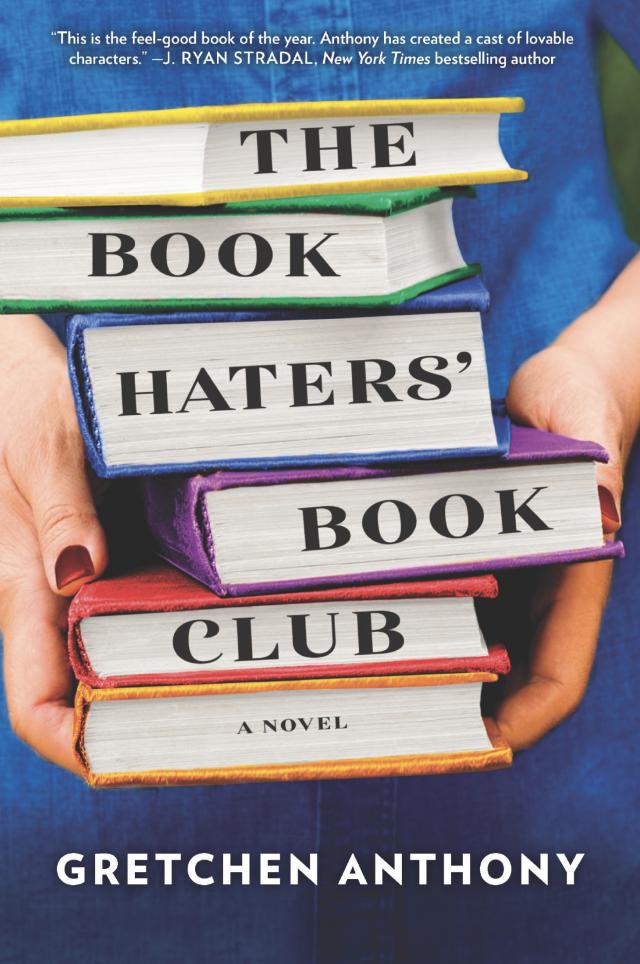
The
Book Haters’
Book Club
Gretchen Anthony
Also by Gretchen Anthony
Evergreen Tidings from the Baumgartners
The Kids Are Gonna Ask
To Bethany and Renee, my forever book club.
Someday we shall ride camels while sipping cosmopolitans from our canteens.
Contents
FOREWORD
PROLOGUE
Chapter 1
Chapter 2
The Book Haters’ Book Club Newsletter
Chapter 3
Chapter 4
Chapter 5
Chapter 6
COMMERCIAL BREAK
Chapter 7
Chapter 8
Chapter 9
Chapter 10
COMMERCIAL BREAK
Chapter 11
The Book Haters’ Book Club Newsletter
Chapter 12
Chapter 13
The Book Haters’ Book Club Newsletter
Chapter 14
Chapter 15
Chapter 16
Chapter 17
INTERMISSION
Chapter 18
The Book Haters’ Book Club Newsletter
Chapter 19
COMMERCIAL BREAK
Chapter 20
Chapter 21
Chapter 22
The Book Haters’ Book Club Newsletter
Chapter 23
Chapter 24
Chapter 25
The Book Haters’ Book Club LIVE
Chapter 26
Chapter 27
COMMERCIAL BREAK
Chapter 28
Chapter 29
Chapter 30
Chapter 31
Chapter 32
Chapter 33
The Book Haters’ Book Club Newsletter
Chapter 34
CURTAIN CALL
ONE LAST THING
ACKNOWLEDGMENTS
FOREWORD
Wake up, wake up, my darling readers, because I’m about to tell you how this book ends. One of our characters will find their way home, another will discover a courage they never believed they possessed, and a third will find their heart.
Wait! you’re saying. We’ve heard this story before. Ah, yes! You’ve spotted your first clues. Good start, darlings! But let me assure you, we’ve only just begun this journey of ours...because that’s the power of story, isn’t it? No matter what we think we remember, a good story is the source of infinite treasure, of gems yet gone unnoticed, of wisdom whispered just for us in the moments we need it most.
This story I’m about to reveal isn’t Dorothy’s (though she’s here and practically bursting to pop in and say hello). It’s not even Laney’s, or Bree’s, or Thom’s, or Irma’s. Oh, they do all the talking and the mucking about, but they’re simply the players. This story, dear reader, belongs to you. It’s yours, and your mother’s, and your best friend’s and your neighbor and him and her and them and all the rest. This is the story of belonging, and of the people we belong not to, but with. It’s the story of dreaming your dreams, and of the loved ones who hold on to those dreams for us when they become too heavy to carry alone.
What’s that? I sound as if I’m talking in riddles? Yes, yes, I know. I’ve always been a wee unconventional, and believe me, I’d like to claim I only mix things up in order to make life more fun. But wait, you’ll see that despite my every grand intention, I create my share of mess—and beauty!—along the way. Which is where we drop into our story.
Let me part the curtains so you can begin...
PROLOGUE
Thom Winslow swept through the glass doors of Vandaveer Investments a titan. “Good afternoon,” he announced to the receptionist, his voice bold, his tenor unwavering. “I’m here for the Over the Rai-iin-bow—” He faltered as the word “rainbow” indiscriminately, and most unpleasantly, stuck to his throat like jelly, leaving him no choice but to clear it with a sickening “HUUCCHH!”
“I’m here for the meeting about the bookstore.” This he said with the voice of a defeated man, aware that his too-narrow shoulders and pigeon neck were rapidly deflating in shame. Damn his rehearsed confidence.
The receptionist barely paid attention, his focus on the tablet attached to his hand. (Was it glued there?) “You’re meeting in the Lake Minnetonka conference room. I’ll escort you.”
Irma Bedford, co-owner of the Over the Rainbow Bookshop with Thom’s recently deceased partner, Elliot, was already inside, waiting. Seeing her, Thom felt a second blow, his vision for today’s meeting all but stomped dead. He’d arrived early to be the first one in the room—he’d read it was a power move—and yet here she was, extending her hand.
“Thom.” She stood when he entered. “They’re running a few minutes behind.”
She was rumpled. He hadn’t expected that. Of the few things Thom appreciated in Irma, it was her easy chic, a style that never failed to impress—well-ironed jeans, crisp white shirt, flawless foundation and knockout lips. Today they were an unfortunate shade of coral.
“Here.” He plucked a tissue from a box on the side table. “Lipstick. On your tooth.”
She accepted it and turned discreetly to fix herself. There was a stain on her back pocket, the flowering blue swell of ink that would never come out, and before realizing, he said, “I’ll walk behind you when we leave so no one can see that spot on your slacks.” It was a kindness she perhaps did not deserve, and yet he couldn’t help himself.
Irma smiled, gratefully. “Before they come,” she began to say but hadn’t finished before James and Trevor Vandaveer, father and son, walked through the door and started the handshaking and back-patting portion of the afternoon. Trevor, the younger, pulled out chairs for Thom and Irma, as if they were elderly, joints too swollen with arthritis to do it themselves. Or in Thom’s case, enfeebled by a set of useless-looking shoulders.
“Will your daughters be joining you, Irma?” Trevor asked.
“Laney’s flight was delayed.” She nodded toward the glass wall behind him. “But here’s Bree now.”
Bree Bedford exited the elevator, armpits sweating through her shirt, the voice in her head hyperventilating about what a stupid mistake she’d made by not having worn a blazer, as usual failing to avoid even one of the mini disasters that, together, comprised her average day.
“I’m sorry to keep you waiting.” The clock on the wall above the crystal water pitcher that looked too fancy to touch read 2:58 p.m., two minutes early. But the energy in the room said she was embarrassingly late. She slipped silently into a chair next to her mother and pulled her planner from her purse for notes. The clasp snapped loudly, echoing against the room’s hard surfaces. “Sorry. Again.”
She and Trevor Vandaveer had graduated high school together, and twenty years on, he looked just as much the tailored son of privilege as he always had, wearing a suit that probably cost more than she was comfortable thinking about. His father, whose first name she kicked herself for not being able to remember, remained the only one standing. She sensed he spent too much time in the sun—though his cheeks and forehead were shiny and taut as if fresh from the dermatologist, the wrinkles on his hands betrayed his age, all but undoing the medical illusion up top.
“We waiting for more?” he barked.
“Just Laney,” Irma, Bree, and Thom said in unison. Irma added, “She texted me a few minutes ago. She’s on her way from the airport.”
It had bee n upon learning that Laney was flying in from California that Bree began to feel anxious about what she might learn at this meeting. Their mother had only said, “With Elliot gone, I’ve enlisted an outside firm to help me make some decisions about the Rainbow.” Bree was more or less the bookshop’s assistant manager—it made sense for her to attend. Her sister, Laney, though, never flew in for store matters. In fact, she almost never flew in for personal matters, either. Their mom’s best friend and business partner, Elliot, had died several months ago and Laney hadn’t flown in for his funeral. She hadn’t flown in when their mom’s late-in-life boyfriend, Nestor, passed away unexpectedly last year, and she hadn’t spent a Christmas or Thanksgiving in Minneapolis for as long as Bree could remember. Laney didn’t come home for things, and yet she was coming home for this.
The receptionist opened the door a third time. “Laney Hartwell,” he announced.
Before stepping through, Laney pulled her baseball cap low and made a wish to whatever god, genie, or fairy watching over her that Old Man Vandaveer would keep on talking. The sooner this was over, the better. She was tired. She didn’t need to be here. It was too big of an ask.
“What are you doing over there?” Mr. Vandaveer saw her choose a seat in the corner and, grossly offended, slapped his notes on the table with a violent, outsize thwak!
She rubbed at the back of her neck, her hair at full attention. “I’m trying not to interrupt.”
“Laney.” Her mother tapped the chair beside Bree. “There’s plenty of room right here.”
“It’s a big table,” Old Man Vandaveer barked, a man showing off his territory—big office, big voice, big dude-jewel ring rapping on his big table’s glass top. “Alright, brass tacks.” He returned to his agenda. “Ms. Bedford, on behalf of Over the Rainbow Bookshop, LLC, has entered into a contract for sale of said business with Vandaveer Investments. Per her request, we’ve agreed to brief you all, her stakeholders, on the terms.”
Trevor handed each of them a slick folder adorned with the firm’s green-and-gold logo. Laney accepted hers, placed it unopened on the table, and set her brain free to wander. It was strange, flying in from her grown-up life in Oakland, only to come face-to-face with a kid she’d graduated with, now an adult with a tailored suit and a haircut too slick for his conservative, monochromatic tie.
“Let’s begin with the Terms of Sale,” Trevor said. The words entered the air, floated around the room. Laney didn’t try to catch them.
“‘...will be paid by the Seller in full upon closing in the form of certified check, agreed to by both Buyer and Seller...’”
Bounce. Bounce.
He had a tiny blue dot above his lip. She’d thought it was an ink spot, a rogue pen leaving its mark. But the more she watched, the more she became convinced. Trevor had a perfect dot of a mole above his lip.
“‘—six weeks,’” the mole said.
“I’m sorry?” Bree’s voice cut through Laney’s foggy thoughts.
“Yes, July 1,” Trevor said. “When Irma signed the Statement of Intent, we agreed to an expedited, six-week timeframe. We’ll sign the final closing documents at the end of the month.”
“But that’s only three weeks from today.” Bree double-checked the date. She was correct. “You sold the shop three weeks ago and you’re just telling us now?” A panicked chill seized her; she didn’t think she could lift her arms. “What about all our customers? What about the neighborhood? We’re the only independent bookstore left in Lyn-Lake.”
“I admit the timeframe is less than ideal.” Her mother did not sound remotely apologetic. “I needed time to get Laney here.”
Bree dug her fingers into the edge of the glass tabletop to keep from crying. Three weeks until her life came to a crashing halt, until the bookshop that had first been her refuge, then family, and then career, ceased to exist. “I don’t understand.” Tears slipped from her chin to the table. “How can you close the Rainbow?”
Irma didn’t respond.
“If you’ll turn to page seventy-nine,” Trevor said, apparently anxious to move the meeting along, “you may understand more after hearing the details.”
“Take a look at the offer price,” his father said. “That oughta dry your boo-hoos.”
Thom pushed the tissue box down the table toward Bree. That Irma was only now telling her daughters of the sale did not surprise him. She was a beauty with fangs, and he’d known from the very beginning it was dangerous to get too close. She and the bookshop had consumed Elliot, and just as a new chapter of their lives was to begin, just as Elliot had agreed to cut back on his work there, to consider retirement, to refocus on his life with Thom, he’d died. In a flash. Gone without warning or goodbyes.
Thom turned to the correct page and looked for the price Irma had received for the beloved Over the Rainbow, aware that no amount of money would ever dull the resentment he’d sharpened for the woman and her bookstore over so many years. Trevor was now spewing gibberish, a tactic meant to blunt the impact of what he could see with his very own eyes: Irma had sold Elliot’s life’s work for practically nothing.
“Oh, Mom,” Bree cried. “Is that all the Rainbow means to you?”
Laney flipped her page, assuming there had to be more on the other side. “So, is this just the first installment or what?”
Thom felt his jaw, followed by stoic resolve, go slack. “Irma,” he hissed.
The woman didn’t flinch. “These are the terms the Vandaveers offered, and I’ve accepted them,” she said, her back an iron rod. “If you have questions, please direct them to our hosts.”
Thom looked at the sale price again, convinced they’d misplaced a comma.
Bree shifted from being quietly tearful to a sobbing soap opera star.
Laney checked her watch.
1
45 days until closing...
Laney Hartwell wasn’t sure which she wanted more: a doughnut, or a divorce. She didn’t really want a divorce, obviously. It’s just that this was becoming another one of those days when it would’ve been nice to have a husband who contributed more to the work of running their small business than simply the use of his fading celebrity. Right now, for example, she was tearing bits of rogue paper, molecule by molecule, from the jaws of their damned-to-be-jammed receipt printer while a line of customers—all anxious to be out the door and on their way—snaked deeper into the waiting area. Meanwhile, Tuck stood oblivious nearby, legs spread, knees bouncing in time to the chorus of adulation in his head, entertaining one man. “I’m telling you,” he boomed, “I may as well have had fire shooting out of my ass—genuine, NASA-grade, rocket-fueled combustion!”
Laney glanced up from her gloom, fingers slathered in printer ink, just in time to see Tuck’s new friend help himself to the last chocolate-glazed on the We Our Customers doughnut tray. The one she’d wanted. “Tuck?” She heard her exasperation leaking. “Could you please come help me?”
They were coming up on twenty years as “Tuck and Laney,” and together, they owned Tire Stud, a tire store on Shattuck Avenue in Oakland beneath the concrete-and-asphalt canopy of CA-24. They had a crew of six mechanics (give or take, depending on who’d recently quit or been fired); 6,500 square feet of space; and as of close-of-business yesterday, 782 in-stock tires. They were nearing the five-year anniversary of its opening, and in that time, she’d had approximately 1,750 days nearly identical to the one she was having now.
As for Tuck, he was a former B-list NASCAR driver—thus, the post-racing life in tires. “Not like I was gonna retire to become a dentist,” he liked to say.
“I saw you at the Stockton Invitational in 2010.” The man who’d devoured the last of the doughnuts was waiting on a front-end alignment. “You blew a tire in the last lap, but up ’til that very last second, I thought you were gonna take it all.”
Tuck slapped him on the back. He only had four-and-a-half remaining fingers on his left hand after a poorly chosen fight with a pneumatic wrench. “I was counting on that race to put me over the top in the standings.”
“Tough break.”
“Well, our treads are better here. I can promise you that.”