Moth, p.1
Moth, page 1


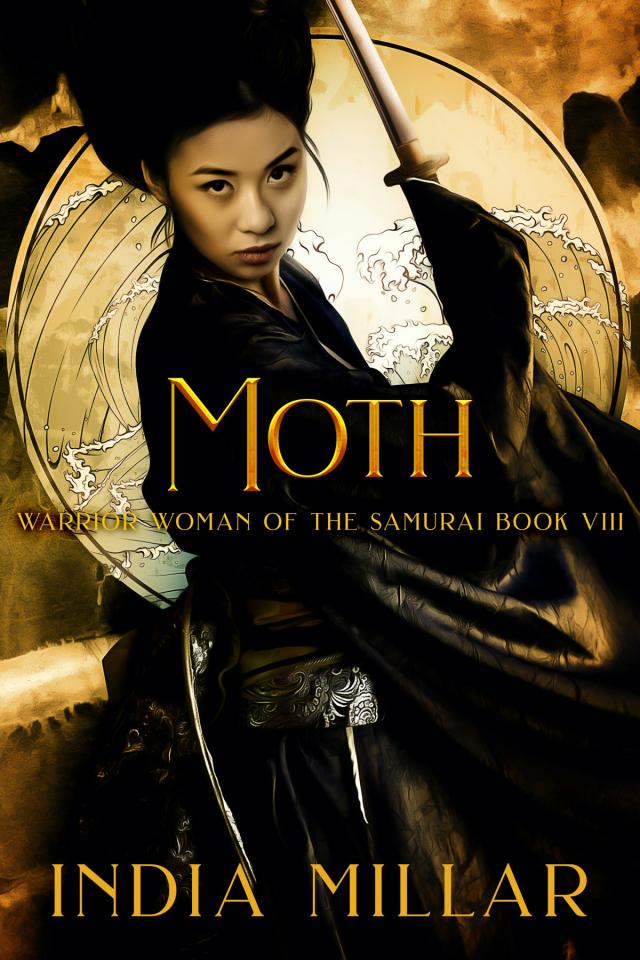
Moth
Warrior Woman of the Samurai Book Eight
India Millar
Red Empress Publishing
www.RedEmpressPublishing.com
* * *
Copyright © India Millar
www.IndiaMillar.co.uk
* * *
Cover Design by Cherith Vaughan
www.CoversbyCherith.com
* * *
All rights reserved. No part of this publication may be reproduced, stored in a retrieval system, or transmitted in any form or by any means, electronic, mechanical, photocopying, recoding, or otherwise, without the prior written consent of the author.
Contents
Also by India Millar
Preface
Prologue
One
Two
Three
Four
Five
Six
Seven
Eight
Nine
Ten
Eleven
Twelve
Thirteen
Fourteen
Fifteen
Sixteen
Seventeen
Eighteen
Nineteen
Twenty
Twenty-One
Twenty-Two
Twenty-Three
Twenty-Four
Twenty-Five
Twenty-Six
Twenty-Seven
Twenty-Eight
Twenty-Nine
Thirty
Thirty-One
Thirty-Two
Thirty-Three
Thirty-Four
Thirty-Five
Thirty-Six
Thirty-Seven
Thirty-Eight
About the Author
About the Publisher
The Song of the Wild Geese
Also by India Millar
Secrets from the Hidden House
The Geisha with the Green Eyes
The Geisha Who Could Feel No Pain
The Dragon Geisha
The Geisha Who Ran Away
The Song of the Wild Geese
The Red Thread of Fate
This World is Ours
Warrior Woman of the Samurai
Firefly
Mantis
Chameleon
Spider
Dragonfly
Scorpion
Cricket
Moth
Haiku Collections
Dreams from the Hidden House
Song of the Samurai
This book is humbly dedicated to Baizenten, the Japanese Goddess of Writers and Geisha. May both you and she enjoy the words written herein!
Preface
Though the sex to which I belong is considered weak you will nevertheless find me a rock that bends to no wind.
Queen Elizabeth I of England, 1558—1603
Prologue
When I was a small child, I was terrified of moths. It was the way they fluttered without purpose toward any light. I was convinced that the poor things were blind, and so of course I felt even guiltier about my intense dislike of the wretched creatures.
It helped not at all that they seemed to be fatally attracted to me. No matter how many people were around me, any moth always made straight for me. A large one landed on my face once and I screamed so loudly, my mother thought I had been badly hurt. As you can imagine, she was not at all pleased when she found that a harmless moth was to blame!
I tried and tried not to be afraid of the poor things, but nothing did any good until one day I was visiting an old lady who was a friend of the family. My mother and I sat outside in her garden in the gathering dusk, and sure enough, the moths started to appear, drawn by the lights she had left on in the house. There were many moths that day. I could do nothing but sit, rigid with fear, as they began to circle me.
Eventually, the old lady noticed I was silent. She patted my arm and asked me what the matter was. Was I cold? Tired, perhaps? My mother laughed and answered for me, telling her that I was frightened to death of the harmless moths. I squirmed with embarrassment, but then realized the old lady was not laughing at me. Instead, she nodded thoughtfully and then told me about an ancient legend concerning moths.
She said that moths are considered creatures that should be venerated as some of them are sure to be the souls of the dead, fluttering around the living so that they may still partake to a small extent in their life.
I did not like that idea at all. Instantly, I thought the reason why moths were so drawn to me was because they wanted to take a little piece of my life for themselves. I shuddered and drew my shoulders around my ears, and the old lady smiled at me kindly.
“That is one legend,” she said quietly. “But for myself, I do not believe it. But have you heard the story of the moth that is called the lucky bug?”
I was interested despite my fear. I shook my head and settled down to hear what she had to say. I loved stories, and this one was new to me.
“Well, this particular moth was so very beautiful that it used to be kept by ladies in a jar on their dressing chest. It was thought to be extremely lucky and was treated as a pet. It is quite a large sort of moth—” She broke off and held her middle finger out to show me. “—Perhaps so long, but far more slender than my finger. The lucky bug has four wings. Two of these are transparent. Perhaps the lucky bug doesn’t like these wings, for it hides them behind another pair of wings. Now, these second wings are different again. They are so glossy, they appear to have been polished, and they are adorned with the most beautiful blue and golden lines and spots. Do you think you would be afraid of such a lovely thing, dear?” she asked me gently.
I thought about it and then took a deep breath before I answered.
“If it fluttered around me and tried to land on me, probably,” I admitted. “Why do moths do that? And why do they fly into fire? Are they blind?”
The important question was asked at last. I could hear my mother tutting impatiently at me, but the old lady took my question seriously.
“No, moths are not blind. They see far better than we do in the dark. And as to why they fly to certain death in the flames? Why, that is all the fault of the lovely lucky bug. Shall I tell you the rest of the story?”
I nodded eagerly, and she settled her old bones with a sigh and went on, but very softly, as if the rest of the tale was for my ears alone.
“I told you that the lucky bug was dazzlingly beautiful. But it was more than just a lovely thing. Its colors were so very bright and shimmering that this moth seemed to have taken fire into her own body. All the other moths couldn’t help but fall in love with her. They gave the poor lucky bug no peace at all. Instead, they fluttered around her constantly, pestering her just as they do you.
“As a result, the lucky bug could find no rest anywhere. Finally, in desperation, she told all the moths that surrounded her that she had prepared a special test for them. If any one of them could capture a piece of real fire for her—fire that burned even brighter than her own gorgeous colors—then she would take the successful moth as her true love, and they would be together for always.
“The other moths were so delighted with her words that they gave it no thought at all. Each of them flew away at once. Some beat their wings against closed lanterns and gave up in despair when they realized they could not reach the flame within. Others found candles and flew straight for the naked flame, only to perish in its fiery embrace. Still others saw glow worms in the trees and battered their wings against them to no effect at all, for none of the glow worms were prepared to part with their cold fire.
“Not one of the moths was successful in stealing fire for the lucky bug. But that has never deterred them. To this day, moths still try to steal flame to please their lady love, and that is why they are willing to risk their very lives by flirting with the flame.”
I was enchanted by the story, although it seemed very sad to me. I felt sorry for the love-lorn moths, but also did I worry about the lonely lucky bug, condemned to be alone by her own words. I asked my new friend about that, and she smiled.
“She was not lonely. She had the company of a beautiful woman, and she regarded that friendship far above anything a moth could give to her. But you should not be afraid of those silly moths that flutter around you, dear. They mistake you for fire, and to them, nothing is more precious.”
I was a quiet, shy child who always shrank from attention. But ever since I was told the story of the lucky bug, I have always known I was fortunate enough to carry a special fire within me.
From that day forward, I lost my fear of moths entirely.
One
Light is always most
Appreciated in the
Darkest part of night
My main concern as I marched quickly away from Toshiro-san’s estate was the safety of my katana. I had thought it lost to me forever. Now, it had been returned to my side, and I was determined that only death would part us again. In spite of my racing emotions, I forced myself to think calmly.
It was tempting to run, but I did not. A brisk march was far better—I could maintain that pace for many hours, whereas a run would quickly leave me exhausted. The militia would be on my track tomorrow. If they found me, I would be taken and executed. My katana would no doubt be claimed as a trophy by one of the officers. I bared my teeth in anger at the thought.
Toshiro-san had been more than merciful to me. I had killed the venerable samurai’s only son. Although he had died in a fair fight, I had broken his father’s heart by my action.
His son’s deat h was an honorable one, and far, far better than the monstrous man deserved. In life, Rai had had no honor at all. He had killed without conscience, purely for his own convenience. His wife had died at his hands when she had failed to bear him a son. My dear friend Hama had been murdered by him when she became a nuisance.
His favorite concubine had avoided death at his hands by some miracle, but to my mind it would have been far more merciful if she had died. Rai had intentionally infected her with the dreaded speckled monster disease and had then thrown her out with no more than the clothes she was wearing. He neither knew nor cared if she lived or died. The disease had left her horribly disfigured and blind, but even knowing what he had done to her, she still loved Rai and lingered outside the family’s country estate, pining for her evil lover.
Rai had even planned to murder his father for nothing more than to gain his inheritance as soon as possible. Had I not been present, he would undoubtedly have succeeded in that most terrible of crimes.
Toshiro understood that I had killed his son to save him. For that reason, he had given me a chance. He could not forgive me for Rai’s death—no matter how terrible the deeds his son had committed, what father could?—but he had allowed me to walk away with my katana at my side and my loyal dog Ken to guard me. But the reprieve was only temporary. It had been evening when I had confessed what I had done to the old man. He had told me that he would wait until morning to pretend to discover the tragedy, and then he would send for the militia. If they found me, he would speak not a single word in my defense.
I understood his decision. We were both samurai, so this was his interpretation of the code of bushido. I was humbled by his mercy, but I knew I had to take full advantage of it if I wanted to live.
As soon as I stepped outside the estate gates, I was stopped by Rai’s maimed concubine, Haruko. The poor woman still deluded herself that one day Rai might take pity on her and take her back into his household. She had warned me once before that if I hurt her lover, she would punish me. I felt tremendous compassion for her, and—in spite of my anxiety to get far away from this place of death—felt I had to spare her a moment to explain that Rai was dead and tell her why I had been forced to kill him.
I had been told that Haruko was once very beautiful, with a singing voice that was so lovely she could break a strong man’s heart when she sang. Looking at her ruined face and hearing her cracked voice now, I knew that I felt no pity at all for Rai. If any man deserved to die, it was surely him. But my heart clenched with pity for his victim. I put my hand out to Haruko, hoping that I could make her understand my actions.
I flinched back as she jerked her head toward me. For a moment, I thought she intended to attack me, to pay me back for my actions with as much hurt as she could manage. But I was wrong. As fast as a snake can spit venom, she spat in my face. I was so shocked I could not move, and a heartbeat later, she spat at me again. For all her blindness, her aim was terribly accurate—her spittle landed fully in each of my eyes.
A mix of emotions coursed through me—pity mingled with disgust. Before I could even wipe my face clean, she had turned and was walking away from me. I wiped and wiped at my face, bewildered by her reaction. I marched briskly forward, wiping my eyes unconsciously as I walked. My whole face felt unclean and I longed to wash it thoroughly. I was sure my vision was slightly blurred, but I dismissed it quickly as being my imagination. Once I could wash my eyes thoroughly in clean water, they would be fine.
Suddenly, I felt unreasonably elated. I was free of all ties. I had done what had to be done, terrible as it was. The militia who would be on my trail shortly would not be able to find me. One of the guards had told me that the nearest town to Toshiro’s country retreat was Toba. That was where I would go. There is always safety in numbers. In a town, I would be one amongst many. Here in the country, I would be the easiest of targets.
If the militia found me, then I would be dead. They would drag me in front of the magistrates, and even if I was given a trial, it would be no more than a mockery of justice. Toshiro had promised that he would pretend to believe my friend Hama had killed his son while he slept—no doubt out of rage that he had refused to take her with him back to the city—and had then killed herself from remorse.
But far as the militia would be concerned, I had been there when Rai died, and I was Hama’s friend. I had run away, so I must have been implicated. They could do nothing to poor Hama, but they could make sure that justice was done when they executed me. I was sorry for the injustice that had been done to Hama, but she was dead. No man’s words could harm her now.
I had to get to Toba. It would be my escape route. In addition to being a sizeable city, Toba was a seaport. Once there, I would find a ship to take me back to Edo. My heart beat faster at the thought—home. I was going home, where I belonged.
Memories crowded my mind, making my steps slow and falter. My family home had been just outside Edo. I reminded myself sternly that I no longer had a home. That had been taken from me when my father and brother were slaughtered by insurgents. Yet Edo called to me. Tears gathered as I remembered the enchantment of Edo’s Floating World, the pleasure center that nobody ever forgot once they had been there. I clenched my teeth in anger as I wondered if it was really the Floating World that was calling to me, or the man I had left behind there.
“Nonsense.” I spoke aloud and Ken looked at me, expecting instruction. “Nothing, Ken. Nothing.”
I wished I could believe my own words. It had been many months since I had last seen Akira, the man who still haunted my thoughts. I shook my head at my own foolishness. How was it possible that I—a samurai with a thousand years of proud tradition behind me—could possibly have fallen in love with a yakuza? Not just any yakuza, either, but the man who was feared by the whole of Edo, rich and poor alike. I had heard tales of the terror he had inflicted. Of torture and death, wicked things done without thought or regret. Yet to me, Akira had been more than just a tender lover, he had shared my soul and understood me like no other man before him. Yet we had parted badly.
Akira’s vengeance had been shocking. His jealousy had been so very great that he had tried to break my mind, and he had almost succeeded when I found out that it was he who had subjected me to the most terrible danger. But he had not succeeded, and in spite of everything, I understood that all he had tried to do had arisen from love, not hatred.
He had promised that we would meet again. Was he still waiting for me to return to him, sure of his hold over me? And when I got back to Edo, would he be the one I turned to? I knew the answer in my soul, and I sighed as I admitted the truth to myself.
As long as I lived, Akira would always be a pebble in my shoe. I wondered if he had taken a concubine—perhaps many concubines—in my absence. I hoped that he had, and then felt ashamed as I admitted to myself that I would still take great pleasure in turning his face from any other woman.
I paused for a moment to order my thoughts. Enough. Edo and Akira were in my future. For the moment, I had other things to consider, most notably saving my own life. I had no money and nothing of value except my katana. I was supposed to be nothing more than a humble Ama, a poor woman who made her living diving for oysters—always hoping to find a precious pearl within—and abalone and all the other good things that were the gift of the sea. Such a woman would have no right to carry a rare and priceless katana, so I must have stolen it. The militia would instantly take it as proof of my guilt and would see it as justification to execute me instantly, without trial.