

Gringos 4, p.1
Gringos 4, page 1
part #4 of Gringos Series


The Home of Great
Western Fiction
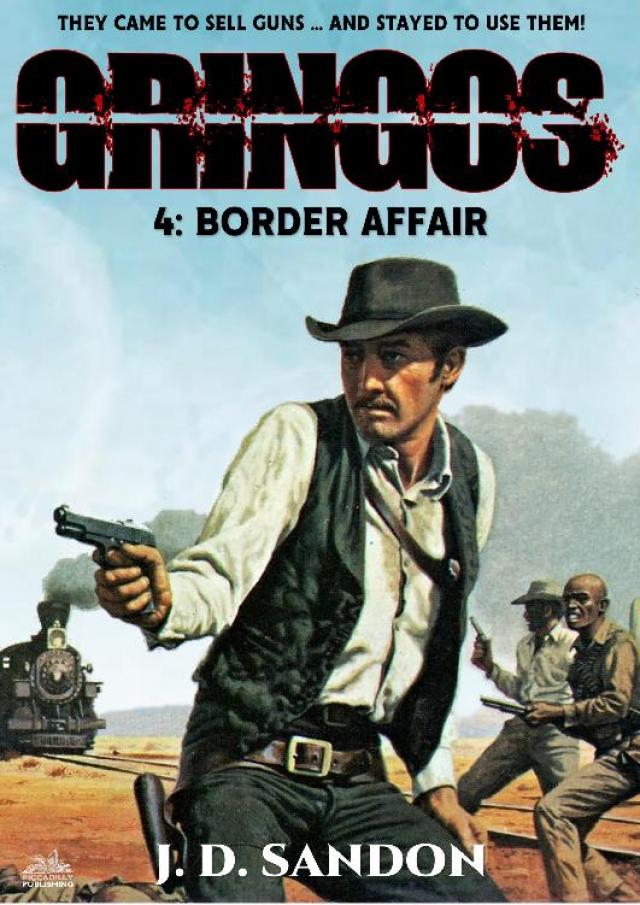
It should have been easy—collecting a shipment of arms in El Paso and running them south of the border to the rebel bandit, Pancho Villa. But in the blood and darkness of revolution nothing is as easy as it seems. Betrayed on all sides, the leader of the Gringos feels the raw rope of a hangman’s noose around his neck. It takes the other Gringos all their furious courage and firepower to save him … except that none of them can ever be saved.
GRINGOS 4: BORDER AFFAIR
By J. D. Sandon
First published by Mayflower Books in 1979
Copyright © J. D. Sandon 1979, 2023
This electronic edition published January 2023
Names, characters and incidents in this book are fictional, and any resemblance to actual events, locales, organizations, or persons living or dead is purely coincidental.
You may not copy, store, distribute, transmit, reproduce or otherwise make available this publication (or any part of it) in any form, or by means (electronic, digital, optical, photocopying, recording or otherwise), without the prior written permission of the publisher. Any person who does any unauthorized act in relation to this publication may be liable to criminal prosecution and civil claims for damages.
This is a Piccadilly Publishing Book / Text © Piccadilly Publishing
Series Editor: Ben Bridges
Published by Arrangement with the Author’s Agent.
Visit www.piccadillypublishing.org to read more about our books.
‘Shoot all the brave horses
And how will we ride?’
—John Stewart
‘ ... when you’re running close to the edge,
Courage is a border affair.’
—Lee Clayton
For Gaby and Angus
Table of Contents
Foreword
Chapter One
Chapter Two
Chapter Three
Chapter Four
Chapter Five
Chapter Six
Chapter Seven
Chapter Eight
Chapter Nine
Chapter Ten
Chapter Eleven
Chapter Twelve
Chapter Thirteen
Chapter Fourteen
About J. D. Sandon
Foreword
IT IS 1915 and Mexico has been split by revolution for five years. Supported by the United States government, the dictator, General Victoriano Huerta, is clinging to power under attack from three sides. In the south the peon army of Emiliano Zapata demands agrarian reform; takes the land back from the absentee landlords and works it itself. In the north-east and north-west two rebel forces fight in an uneasy alliance. Venustiano Carranza, the governor of Coahuila province, and his army under Alvaro Obregon are supported by the guerrillas of the bandit, Pancho Villa.
But neither Carranza nor Villa trusts the other. Carranza has his eyes fixed on Mexico City and control of the whole of Mexico. He sees Villa as a rival who will have to be stopped—or eliminated.
The United States, reasoning that Huerta cannot maintain his position, is ready to throw in its lot with Carranza as the man most likely to restore stability and therefore protect American commercial interests.
The embargo on sales of arms to rebel forces is lifted in Carranza’s favor, but as far as Pancho Villa is concerned arms traffic across the border is still illegal.
Nevertheless, there are men who are prepared to risk their lives in both supplying and fighting for Villa and the rebel cause—if the price is right.
Such men as the Gringos.
Chapter One
DURANGO. DUST LIKE a ridged shroud stretched tight across the ground. Dust attacking the crops like locusts. Dust coating man and animal, clogging the eyes, the ears, the mouth, infiltrating the pores, the mind. To the east a pale disc of sun seen through a gray filter that never fully disappears. Westwards the shadowy beginnings of the Sierra Madre.
McCloud turned his head sideways and spat. A small ball of phlegm that rasped from his throat and was lost as soon as it hit the earth. McCloud wiped the back of his hand over his mouth and only dragged more dust across it. Inside his head he cursed; when that wasn’t enough he threw back head and hollered at the sullen sky. The words were swallowed up. The guerrilleros riding behind him paid little attention—they knew the land and they were getting to know Yates McCloud.
McCloud thought of the New Orleans delta. Wide expanses of blue, bright and clean; the even, green land; plantation houses painted gleaming white. Women in long, flowing dresses with tight waists and bodices that displayed the tops of their breasts; skin that shone and smelt of organdie.
Why had he ever left the South to become involved in this crazy venture?
McCloud’s mind dulled: he knew only too well why he had been forced to leave, disowned by his family, wanted by the law ...
He shook the memories clear and turned in the saddle. The dozen men rode behind him in rough lines; short, dark jackets over white cotton shirts; loose, white cotton trousers; wide sombreros. Kerchiefs to their faces. The coats were crisscrossed by heavy ammunition belts. All were armed. Some wore a gun belt with a pistol holstered below the hip—single action Colt .45s, Colt Lightning .38s stolen from the federales, Remington .44s, double-action Starrs. Others had their guns pushed down into the waistband of their trousers. Most of them had rifles also, either sheathed by their saddles or held in their hands. There were a couple of captured Winchester ’95s and an assortment of earlier Winchesters mixed with Enfields, Spencer carbines, Henrys and Sharps.
They all had knives, one, perhaps two each. The length and shape of blade varied widely; what remained constant was the sharpness of the well-honed steel.
There had been rumors of a small detachment of federales in the area and Villa had wanted them tracked down and dealt with. But tracking anything in such conditions was almost impossible. As soon as tracks appeared so were they covered up. As soon as a movement was spotted, so it disappeared in swathes of dust. They would return to camp empty-handed, McCloud was sure of it. Back to tortillas and chili beans washed down with raw red wine. Then the seemingly endless singing and the women who followed Villa’s men everywhere. Then steep and then another day.
McCloud scowled. Within two days he could be at the border. Once there he could go west and avoid any lawmen who might recall his name from a crumpled, slightly fading poster. He could move up the western seaboard and begin to practice with the cards, find work as a gambler. Soon it would be soft sheets, good food, brandy, girls with ringleted hair who didn’t stink of state sweat and have flesh that rolled from their bones whenever they moved.
He ...
The first volley of shots ripped through the morning and tore it apart. Sudden spurts of orange that penetrated the gray; the metallic fast rattle of automatic fire. McCloud pulled hard at his reins and his horse reared up, nostrils flared back as it sounded its fear. Behind him two men were flung to the ground, bleeding heavily, dying and so close to death that they could only move their lips to express pain and not to pray.
The guerrilleros at the rear had turned and started to gallop back in the direction they had come. An outburst of rifle fire put any such thoughts from their minds. McCloud brought his horse under control and pulled the Colt Lightning .38 from its shoulder holster. Bullets screamed about him; animals plunged and men shouted. The east seemed to be the only direction not shut off and McCloud kicked hard at his mount with his heels and called an order that went largely unheard.
The flat track they had been following became uneven stony ground and started to rise. Dust whirled about his head. A figure suddenly appeared close to his right, as if rising up from the earth. McCloud saw a mustachioed face, a broad-brimmed hat, a rifle; he swung round his Colt and fired. The body jerked backwards, face contorted in an instant of agony.
McCloud dug in his heels once more, looking fast over his shoulder to see if his men were following.
Shapes moved forward towards him.
As he swung his head back to the front, his horse lost its footing on the rough ground and stumbled, head reaching down, front legs folding.
McCloud let go of the reins and freed his boots from the stirrups, throwing himself sideways. The horse fell heavily and he hit the ground with his left shoulder and hip, immediately rolling away. He stopped his movement with his left hand and came up into a crouch, the Colt still tight in his right.
For a moment he could see nothing; there was only the sound of hoofs and the repeated clatter of gunfire. When he did pick out movements it was not easy to tell whether they were friend or enemy.
‘Señor! Señor!’
McCloud recognized one of Villa’s men and ran in his direction. There were five of them in all, taking cover from a ridge of land that stretched from north to south. One of them glanced up at McCloud and grimaced, a wound high in his shoulder leaking dark blood onto his shirt and coat.
‘We found them, señor. The federales.’
McCloud rested his elbow and levelled the shortened barrel of the .38 towards the swirling dust.
‘Maybe,’ he said. ‘Maybe.’
They came with a rush, riders charging four abreast, the sun a ghost above their heads. McCloud chewed on the soft flesh inside his lower lip and squinted along the barrel, waited.
‘Now!’
He yelled and fired simultaneously. The man to the left of the group threw up his rifle and swerved his horse at a tangent, f alling from the saddle, always falling. McCloud grinned and shifted his aim, fired again. Again. On either side of him Villa’s men spent shot after shot.
A single rider survived the charge and leapt his horse over the crouching figures. As he tried desperately to turn it, hands reached up at him and caught his legs, his flailing arm and dragged him out of the saddle. Watching, McCloud saw three of them around him; saw the muted glint of a knife; rise and fall, rise and fall. Soon the screams were only echoes of themselves and the blade was being wiped clean.
‘Here they come!’ McCloud shouted, pushing fresh shells into his gun and tightening his grip of its curved butt.
There were less of them this time and they swerved away before McCloud and his men could do much damage. Slowly the disturbed dust began to settle and they reloaded and rested; one of them cut away the arm of the wounded man’s coat and ripped off the shirt sleeve, trying to stanch the flow of blood from his wound.
McCloud sent a man back to explore the terrain. When he returned, his face told the news before his words. After less than ten yards they were up against high rock, almost sheer and unclimbable. The only ways out were forward or to the sides.
‘They could have gone,’ suggested one. ‘Pulled back.’ McCloud shook his head, not believing it.
‘What do we do?’ asked the man, his head to one side.
‘For now, we wait.’
The man shrugged and looked away. It was still, near silent. Occasionally they could hear the moan of the wounded man out there in the dim dusty landscape, hidden from sight. He could be one of their own or one of the enemy. Whoever he was he would suffer and die alone.
They had been twelve and now they were five: seven men cut down in that first ambush of cross-fire. McCloud lay there, hating the damned country more than ever; knowing that if he had to die somewhere, sometime—and he supposed that he did—he didn’t want it to be in the middle of that suffocating Mexican dustbowl.
‘Señor, let me try to find a way through. They may have gone. We have heard nothing a long time.’
McCloud looked at the man. Behind the sweeping brown moustache and the stubble of beard the face was little more than a boy’s. The brown eyes stared at McCloud, inquisitive and anxious, waiting for an answer.
McCloud looked past him, out into the gray blur.
‘Okay,’ he said. ‘Go slowly. See what you can find out.’
The brown eyes smiled, the head nodded; the man turned, pulling his pistol from his belt. Within less than a minute he was shielded from sight.
The five men waited, occasionally glancing at one another. Four minutes, five ...
‘Señor, perhaps ...?’
‘We wait.’
‘But if he does not come back?’
‘Then they’re still out there and they’ve got him. There ain’t no point in sneakin’ out one at a time and being picked off.’ The Mexican nodded and looked outwards, making the sign of the cross over his chest, lips working at a silent prayer.
It was answered: the man came back.
There was a sound like shuffling and a single, racking cough. McCloud levelled his Colt, unsure what to expect. Gradually a shape pushed itself forward, materializing out of the dust. He was dragging himself with his left hand and elbow, pushing with his knees and feet. Every yard he stopped to catch his breath and summon up the energy to continue.
Two men ducked away from their cover and hurried, crouching, towards him. McCloud cursed, half-expecting a volley of shots from the enemy but it didn’t come. Instead they were able to drag the wounded man back, his head slumping forward and grazing the hard ground.
They had heard no shot and the reason was clear. The reason was a wound which had opened his back diagonally, from right shoulder blade to just above his left hip. Whatever had been used had been both sharp and heavy; the wound was close to three inches deep at the center and the flesh had folded outwards like fruit bitten into by a large bird.
The inside of the wound was lined with dust, so that the raw bloody fiber was coated in a film of gray. Through this, at intervals, brighter lines of blood ran out and down his back, small flies and insects greedily feeding off them before they reached the earth.
McCloud leaned over and lifted the man’s head. The brown eyes were glazed and unable to focus; the face looked young no longer, but old, very old. As he held him, the man’s mouth jerked suddenly open and a mixture of blood and vomit spurted over McCloud’s hand. He moved his hand away quickly, the head slumping back to the ground.
‘They are still there, señor.’
McCloud nodded. While the dust stayed like it was he guessed it was the easiest thing for them to do. They could wait as long as they wanted. If more men tried to find a way through they would see them and kill them easily, one at a time. If McCloud and the others waited until the dust storm began to clear, they would be like so many sitting ducks.
‘There’s one place we can go,’ said McCloud after a few moments’ thought, ‘and that’s back.’
‘But, señor, the rock, she is ...’
‘We can try. Not to climb over but to find better cover. Somewhere it isn’t goin’ to be so damned easy to shoot us down without our even being able to fight back.’
The two men rode side by side, their horses walking easily over the stubbled land. Three, maybe four days ago, where they were riding had been a flourishing crop, now it was nothing but acre after acre of charred stems. Instead of green and yellow there were brown and orange. Man-made devastation in a country where so many people were close to starving.
‘Say one thing, Major, that ash goes back into the soil and makes it rich. Better crop next year.’
Onslow’s gaze swept over the land and then settled back on the face of the man alongside him. ‘If there’s anyone still alive to plant it,’ he said.
Cade Onslow was no longer a major in the United States Army, though those around him often used the title. Onslow had said farewell to the army after a bitter disagreement with his commanding officer; he had married the daughter of a Mexican landowner and looked forward to a life of happiness south of the Rio Grande.
But Mexico’s troubles were no respecters of personal happiness, any more than they were respecters of the crops in the fields. Linda was killed in an attack made by the federales upon the hacienda in which a band of rebels had taken refuge.
With that death so much of Cade Onslow died too.
He stayed in Mexico to fight: to fight against the ruthless government forces who had needlessly caused his wife’s death. And because his own country was closed to him.
Onslow was a man without a land of his own; maybe now he was fighting to find one to save one. More than the other Gringos he had come to genuinely sympathize with the causes of the revolution. Now when he fought it was for more than the money it earned him as a mercenario; more than his hatred of the federales for what they had done to his beautiful young wife; it was for the downtrodden peones of Mexico that they might regain the land and its wealth and share it amongst them.
Jonas Strong also had a natural sympathy for the peasants of the country in which they rode. As a Negro who had grown up in the United States and then fought in its army, he knew about prejudice and the absence of justice; knew about being treated as beneath contempt, unclean and unworthy. He sensed that the cause of the rebels was just, but his greatest adherence was to Onslow himself.
That Strong had been able to rise in the army to the rank of sergeant was almost entirely due to Onslow’s efforts on his behalf. So when Onslow had left the army Strong had left with him. Wherever the major went, Jonas Strong would be at his side, no matter how dangerous or foolhardy.
Onslow reined in his horse and pointed to the east where a near-black wall shifted slowly, covering the space between land and sky. ‘Some poor bastards are sure getting choked in that one.’
‘You bet,’ Strong agreed.
Onslow flicked his reins and then stopped a second time, listening intently. ‘You hear that?’
Strong cupped his hands to his ears, shook his head, until the muffled sound of gunfire registered on him too.






