My favorite mistake, p.1
My Favorite Mistake, page 1


Copyright © 2024 Marian Keyes
All rights reserved. The use of any part of this publication, reproduced, transmitted in any form or by any means electronic, mechanical, photocopying, recording or otherwise, or stored in a retrieval system without the prior written consent of the publisher—or in the case of photocopying or other reprographic copying, license from the Canadian Copyright Licensing Agency—is an infringement of the copyright law.
Doubleday Canada and colophon are registered trademarks of Penguin Random House Canada Limited
Library and Archives Canada Cataloguing in Publication data is available upon request.
Title: My favorite mistake / Marian Keyes.
Original trade paperback ISBN 9780385675390
ebook ISBN 9780385675406
This book is a work of fiction. Names, characters, places and incidents are products of the author’s imagination or are used fictitiously. Any resemblance to actual events or locales or persons, living or dead, is entirely coincidental.
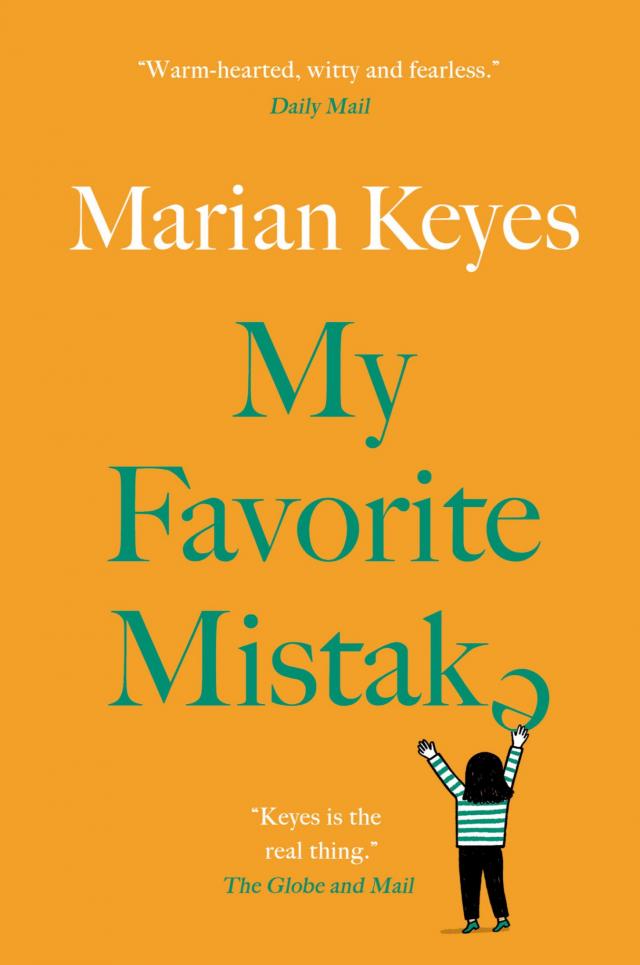
Cover: adapted from a design by Lee Motley // MJ
Cover illustration: Gemma Correll
Typesetting: Terra Page, adapted for ebook
Published by Doubleday Canada,
a division of Penguin Random House Canada Limited
and distributed in the United States by Penguin Random House LLC
www.penguinrandomhouse.ca
a_prh_7.0_147685776_c0_r0
Contents
Copyright
Dedication
Epigraph
Chapter 1
Chapter 2
Chapter 3
Chapter 4
Chapter 5
Chapter 6
Chapter 7
Chapter 8
Chapter 9
Chapter 10
Chapter 11
Chapter 12
Chapter 13
Chapter 14
Chapter 15
Chapter 16
Chapter 17
Chapter 18
Chapter 19
Chapter 20
Chapter 21
Chapter 22
Chapter 23
Chapter 24
Chapter 25
Chapter 26
Chapter 27
Chapter 28
Chapter 29
Chapter 30
Chapter 31
Chapter 32
Chapter 33
Chapter 34
Chapter 35
Chapter 36
Chapter 37
Chapter 38
Chapter 39
Chapter 40
Chapter 41
Chapter 42
Chapter 43
Chapter 44
Chapter 45
Chapter 46
Chapter 47
Chapter 48
Chapter 49
Chapter 50
Chapter 51
Chapter 52
Chapter 53
Chapter 54
Chapter 55
Chapter 56
Chapter 57
Chapter 58
Chapter 59
Chapter 60
Chapter 61
Chapter 62
Chapter 63
Chapter 64
Chapter 65
Chapter 66
Chapter 67
Chapter 68
Chapter 69
Chapter 70
Chapter 71
Chapter 72
Chapter 73
Chapter 74
Chapter 75
Chapter 76
Chapter 77
Chapter 78
Chapter 79
Epilogue
Acknowledgements
For Beth Nepomuceno, with love and gratitude
His gaze moved over my face. “I’m trying to remember the last time we actually met…”
My heart almost seized up in my chest. Were we really going there?
He glanced away, then refocused, all bright-eyed candor. “Was it my engagement party to Elisabeth?”
That was the last time we’d occupied the same room. But we hadn’t even spoken that night.
“So about eight years ago?” he said.
“About that.” (It was eight years and four months.)
He was trying to set the tone for the next two or three days. We could neither ignore nor acknowledge our long and complicated history. But by presenting a sanitized version of events, he was laying out a surface we could walk on. It was as fragile as thin ice over a deep, dark lake but if we stayed light and careful, we could probably do it.
1
There’s more to this story than the clickbait headlines, but yes, in simple terms, I had a dream life—then I took a flamethrower to it. In no particular order, I broke up with my long-term partner, bought a small loom, gave away all my stilettos, resigned from my fabulous-if-frightening job, got into a situation in the street with five teenage boys, received a medical diagnosis which didn’t delight me, bought a slightly bigger loom and, after living in Manhattan for nearly twenty years, relocated back to Ireland.
The first sign that something was up came one Friday morning, in an apartment on the Upper West Side, eight months into the pandemic. Deep, discordant moans dragged me from the depths of sleep.
A quick look at my phone confirmed I was still entitled to a precious sixty-seven minutes of slumber and I flared with fury.
The first time I’d ever heard the atonal groans, I’d thought Angelo was in the next room playing a didgeridoo. But the noise came from a large group of monks. Not actually clustered in their orange robes in Angelo’s living room, swinging their canisters of butter-tea, but on Zoom from Tibet. Having been prematurely woken by them most mornings for the last several weeks I felt as if I knew each one personally.
Effing lockdown.
Angelo Torres and I had been in each other’s lives for over a decade. We loved each other, spent at least four nights a week together but had always kept our own places. Slightly irregular perhaps, but it worked.
Then along came Covid. Angelo and I had to choose between living together in a bubble or being separated indefinitely. We went for the bubble and we picked his place because it was bigger.
But being trapped together almost all day every day, in an apartment that seemed to shrink by the hour, was tougher than expected.
The monks were still giving it socks out there so I pawed for my earplugs. The most important thing was to not think about work. If even one thought got in, it would destroy any chance of getting back to sleep.
You’d never think from the nervy state of me, curled in a resentful knot in bed, that I had The Best Job In The World. But ask anyone. As a senior executive at “legendary” New York PR firm McArthur on the Park, which represented some of the most covetable cosmetic brands on the planet, I could have as much free product as I wanted.
This was to the utter amazement of all who had known me during my under-achieving teens and twenties. Especially my family, where I’d occupied the Failure slot for so long they considered making it a lifetime award.
(Admittedly, getting the job was a bizarre stroke of good fortune, nothing more. I wasn’t—and I’m still not—a go-getter.)
In my crazy-happy early days, they could have paid me in blushers. But in fits and starts, I’d been given responsibility, respect and decent money.
…But I’d also accumulated anxiety. Lots of it.
It had always been a…let’s call it a lively place to work: best suited to those with robust central nervous systems. Take your B vitamins, would be my advice. My life was polished and stressy: early-morning manicures, meetings with powerful neurotics, last-minute flights to Bologna.
Looked at objectively, cosmetics are never a matter of life and death, but when you work in that pressure-cooker world, you sort of forget. Until one day you find yourself more worried about bagging a five-star review for an eyebrow pencil than the state of the planet.
The big boss, Ariella McArthur, doled out extra responsibility—more fear—like it was a delicious treat. Throughout my thirties I’d been resilient enough to power through the terror. But more recently, whenever I “won” a new account, I had to swallow repeatedly and tamp down the urge to howl.
Another look at my phone told me I still had sixty-one minutes of sleepy time. Sternly, I reminded myself that my current set-up was absolute paradise compared to countless others’—a roof over my head, a steady income and enough lifting and firming serum to keep a small nation perky. I needed to cop on and be positive and accept these strange days, so I tried to hook on to the chanting sounds, lengthening and deepening my breath in time with them. Glorious, gorgeous sleep was once again creeping over me when the chime of a prayer bowl vibrated through the apartment, trembling the surface of my glass of water and sending a mascara trundling across the dressing table and bouncing onto the floor.
This was too much! I flung back the duvet, sat upright in bed and declared, “For God’s sake!”
Moments later the bedroom door op ened and there was Angelo, a leather gong in one hand. “Problem?” He was icily polite.
Yes, problem.
Oh, without a doubt, there was a problem, lots of them in fact. The monks were only the start of it. My body clock was badly out of sync with Angelo’s: I got a buzz from exuberant late-night Peloton classes; Angelo went to bed at nine thirty. (On Tibet time, I used to say. Only in my own head but I suspected he knew.) He liked us to prepare an adventurous evening meal together; since lockdown had kicked off, I preferred to graze all day long on cheese, apples and protein bars. To combat my anxiety, he urged me to join him in daily mindfulness but I got better results from wine.
That Tuesday morning, Angelo and I glared at each other. Despite my fury, the truth presented itself in all its stark glory: after so many happy years (and one very unhappy one), Angelo was driving me mad.
More alarming was his inability to hide his irritation with me. Angelo was a wonderful person who tried hard to practise patience towards his fellow man. That he could no longer keep his exasperation under control was a sign we were in big trouble.
We won’t survive this.
I was scared stiff. Then exhilarated, relieved, sad, anxious, hopeful and confused all at once.
2
Maybe if my love for Angelo was all that had soured, my life in New York could have been salvaged.
The second warning sign, like the first, was just one short conversation. But it was the most recent of a tower of almost identical conversations, stacked one on top of the other. That particular Tuesday, it reached critical mass.
As soon as Angelo had stalked off with his gong, I’d reached for the landline to call Mum. In those terrible days, trapped in the US while my parents and four sisters were three thousand miles away in Ireland, I rang home every few hours.
My greatest terror was of my parents catching Covid, because from all the evidence, they were unlikely to survive. Daily, I wasted countless hours doom-scrolling. The dangers kept changing, becoming a different version of the same disaster. There was always something new to panic about: extra symptoms, different variants, allergies to the vaccine…
Often I’d wake in the middle of the night, so choked with fear I’d have to make a quick call to one of my sisters, usually Claire (the eldest and most controlling), asking, “Are they sanitizing their shopping properly?” Or, “Any idea when the vaccines might start?”
At that stage, thanks to various rules and bans, it had been eight months since I’d visited Ireland. The biggest impediment was having to quarantine for ten days on my return to the US; I couldn’t get that long off work. But there had been recent intimations that this requirement would be dropped—so hopefully soon I could fly home for a much-needed visit.
I could not wait to get on that plane.
Which goes to show that life really is full of surprises! It wasn’t so long since I’d hated planes, all airports, even the word “gate.” Overhearing “Tray table” and “upright position” filled me with tearful fury. All because my job made me go to Switzerland every six weeks.
May I pause here to offer some unsolicited advice? If your job involves air travel, never complain about it. Oh, how expressions curdled when I bemoaned my lot. How angry everyone’s response. “Boo fucking hoo, Anna! Flying business class to the land of crystal air and excellent time-keeping. You want me to play the world’s smallest violin?”
“But my carbon footprint is horrifying and my circadian rhythms are shot.”
“Carbon footprint? Circadian rhythms? Wow, Anna, is there nothing you don’t have?”
“Listen to me.” (Usually uttered through clenched teeth.) “I land in Zurich at six a.m. on a Monday morning, my body convinced it’s midnight on Sunday—because back in the US, it is. I’m ferried straight into the Lucerne Bio HQ, where I work two thirteen-hour days, fly back to New York, directly to the office, staying late to catch up on my other accounts. I live on coffee, melatonin, adrenaline and unbearable guilt about the planet.”
“That so?” (Often accompanied by a pugnacious jut of the chin.) “I live on lost dreams. My life story could be called The Flights Not Taken.”
But having been grounded for eight months, my attitude had changed. As soon as the draconian restrictions were lifted, a magical plane would take me to Ireland, perhaps even in time for Christmas. I hit my parents’ number and heard it ringing.
There was a click, then with a heavy sigh, Mum said, “What now?”
She didn’t have caller ID.
“I might not have been me,” I said. “I could have been someone else.”
“Who else would it be?”
“Well? Any news?”
“Since you rang six hours ago? Hold on, actually, I have—you’re banned! You can’t come into Ireland!”
“What have I done?”
“Not just you, you gomaloon, all ‘persons from the US.’ New rules from the government; that eejit was on the telly again. If you came, you’d have to quarantine for two weeks in a rotten oul’ hotel and be charged a small fortune!”
“Mum.” I felt absolutely sick to hear this. “Why are you so excited?”
“Because it’s exciting.”
“…But it’s bad exciting.”
Suddenly gloomy, she said, “I’ll take what I can get.” Then, “Lookit, I’ve no symptoms, neither has your father, we’ll do our best not to catch Covid before your next call. Talk cha!”
Desolate, I hung up. Mum was making light of something terrible, but it hit me like a train that I might never see her or Dad again. People died, I knew it for a fact.
That was when something began to turn, a retreat from the life I had and a circling back towards the place I’d come from. Why was I trapped in this city when, with the exception of Angelo, everyone I loved lived in a faraway place?
Even before the pandemic, a drift had begun from New York. My friend Nell fled to rural Kentucky, to a life with hens, chicken wire and barky dogs. Another friend, Maira, relocated to Nevada and my beloved colleague Teenie returned to her native Oregon. Without exception, they insisted they were happier. Obviously anyone brave enough to leave New York had to talk a good game, but I believed them.
That particular morning, as I frantically googled “Latest Covid Restrictions Ireland,” and discovered that Mum hadn’t been exaggerating, I vowed that once this ended—if it ever did—I was moving my life back home.
3
I’d delayed it as long as I could but it was time to start work. At my desk in the spare room, before I’d even clicked on my new emails, my heart rate increased.
* * *
—
“Honey?” Behind me, Angelo put a calming hand on my shoulder. “You need anything?”
Gratefully, I reached up to grasp his wrist. “Thank you. Can I—”
“The usual? Got it.” He kissed the top of my head, grabbed a mask and left the apartment to buy a decaf latte and a muffin. I exhaled. He was an angel—the kindest, the most supportive man. My earlier burst of irritation shamed me. I could hardly complain about Angelo’s spiritual capers; they made him the amazing person he was.
Proof—he’d gone down to the outside world to buy me hot, calming things even though he was busier than I was. He worked as an art dealer, a job title I automatically translated to “con man,” at least before I knew him.
He’d come into my life via my sister Rachel, who moved in the same Personal Growth circles as him. (They’d first met at Finding Inner Peace While Your World Burns. Just leaving that there.)
Rachel, an addict in recovery, was on an open-ended quest for enlightenment. All Angelo had was a commitment to being “The best version of himself.” To use my best friend Jacqui’s phrase, he was a full-blown Feathery Stroker.
The concept of a Feathery Stroker dated back to the early aughts when Jacqui had spent a disappointing night with a man who’d done nothing but stroke her in a gentle “feathery” fashion. She’d have preferred to be flung about the bed, perhaps even to have an inexpensive item of clothing torn from her body.
Describing a drama-free, drippy man, the phrase was an instant hit. But as time passed, it widened to encompass men who noticed you’d had your hair cut, men who were good to their mothers, men who ordered a dessert that wasn’t cheese and men who changed their sheets more than once a year. It was a damning diagnosis.