

Hot maroc, p.1
Hot Maroc, page 1
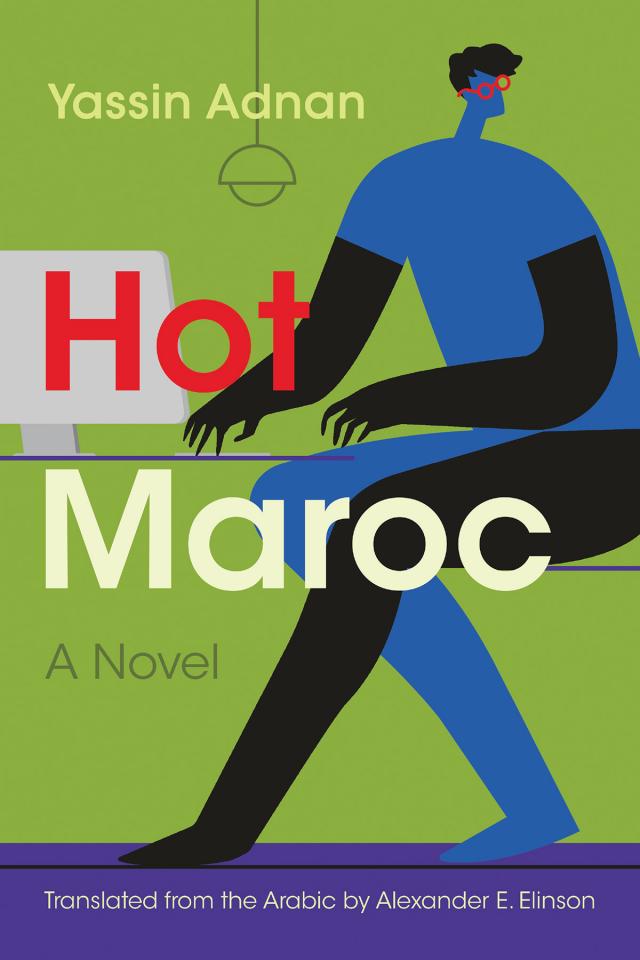


Hot Maroc
Middle East Literature in Translation
Michael Beard and Adnan Haydar, Series Editors
SELECT TITLES IN MIDDLE EAST LITERATURE IN TRANSLATION
The Ant’s Gift: A Study of the Shahnameh
Shahrokh Meskoob; Dick Davis, trans.
The Book of Disappearance: A Novel
Ibtisam Azem; Sinan Antoon, trans.
Gaia, Queen of Ants
Hamid Ismailov; Shelley Fairweather-Vega, trans.
Hafez in Love: A Novel
Iraj Pezeshkzad; Pouneh Shabani-Jadidi and Patricia J. Higgins, eds.
The Heart of Lebanon
Ameen Rihani; Roger Allen, trans.
The Slave Yards: A Novel
Najwa Bin Shatwan; Nancy Roberts, trans.
Tenants and Cobwebs
Samir Naqqash; Sadok Masliyah, trans.
Turkey, Egypt, and Syria: A Travelogue
Shiblī Nu‘mānī; Gregory Maxwell Bruce, trans.
For a full list of titles in this series, visit https://press.syr.edu/supressbook-series/middle-east-literature-in-translation/.
The events of this novel are entirely fictional; its characters bear no relation to real life. Any resemblance to real persons or correspondence to actual events is due to a weakness of the writer’s artifice.
This book was originally published in Arabic as Hot Maroc (Cairo: Dar al-‘Ain Publishing, 2016).
Copyright © 2021 by Alexander E. Elinson
Syracuse University Press
Syracuse, New York 13244-5290
All Rights Reserved
First Edition 2021
212223242526654321
∞ The paper used in this publication meets the minimum requirements of the American National Standard for Information Sciences—Permanence of Paper for Printed Library Materials, ANSI Z39.48-1992.
For a listing of books published and distributed by Syracuse University Press, visit https://press.syr.edu.
ISBN: 978-0-8156-1135-6 (paperback)978-0-8156-5539-8 (e-book)
Library of Congress Cataloging-in-Publication Data
Names: ‘Adnān, Yāsīn, author. | Elinson, Alexander E., translator.
Title: Hot Maroc : a novel / Yassin Adnan ; translated from the Arabic by Alexander E. Elinson.
Other titles: Hūt Mārūk. English
Description: First edition. | Syracuse : Syracuse University Press, 2021. | Series: Middle East literature in translation | Summary: “After becoming enamored with the internet and the thrill of anonymity he finds there, Rahhal Laâouina opens the Atlas Cubs Cyber Café, where his patrons include politicians, journalists, and hackers. However, Rahhal soon finds himself mired in the dark side of the online world—one of corruption, scandal, and deception. Adnan presents a narrative of contemporary Morocco—and the city of Marrakech—with an infectious blend of humor, satire, and biting social and political commentary”— Provided by publisher.
Identifiers: LCCN 2021003904 (print) | LCCN 2021003905 (ebook) | ISBN 9780815611356 (paperback) | ISBN 9780815655398 (ebook)
Classification: LCC PJ7910.D535 H8813 2021 (print) | LCC PJ7910.D535 (ebook) | DDC 892.7/37—dc23
LC record available at https://lccn.loc.gov/2021003904
LC ebook record available at https://lccn.loc.gov/2021003905
Manufactured in the United States of America
“Years of treachery will befall the people when the liar is deemed truthful and the truthful one is deemed a liar; when the deceitful one is deemed faithful and the faithful one is deemed deceitful; and when the Ruwaybida makes pronouncements.” It was then asked, “Who is the Ruwaybida, O Messenger of God?” To which he replied, “He is the worthless man who speaks on behalf of the masses.”
—Hadith
If what they see is good, they cast aspersions on it
And if what they see is evil, then everyone fights for it.
No one is safe from harm
And no one ignores a misdeed.
—Ibn Durayd al-Azdi
We only hide that which is truly meaningful and genuine.
That is why vile feelings are so powerful.
—Emil Cioran
Contents
Translator’s Note
The Butterfly on Its Way to the Slaughterhouse
The Squirrel Enters the Blue Box
The Animal Comedy
Translator’s Note
YASSIN ADNAN is a lover of language. A poet, literary critic, and cultural journalist, he is a writer who is highly attuned to the great richness of the Arab literary tradition, and the linguistic diversity of Arabic as it exists today in Morocco. One of the great challenges and joys of translating Hot Maroc was carrying this diversity over into English. Arabic is no different than other languages in that it is comprised of many registers that express and are determined by context and class—social, political, racial, educational, economic, and more. Arabic can be described as diglossic, or multiglossic. That is, Arabic has distinct varieties that are used under different conditions. The most basic division of labor in Arabic is between speaking and writing, and across the Arab world, in any given place, the spoken variety can be quite different from the written, and there are multiple levels of the spoken register. As for the written language, it is somewhat standard across the Arab world, but there is local variation, and different registers of the written language exist as well. In this translation, I have done my best to reflect the linguistic multiplicity that exists in Morocco today. As Adnan moves deftly between varieties of spoken and written Arabic, the reader is able to sense, to hear, the voices as we move through slums, university classrooms, upscale and working-class neighborhoods, political rallies, and all sorts of online worlds.
While my translation strives to remain as true to Adnan’s Arabic as possible, I have also allowed myself some flexibility to reflect the rhythm and rhyme of poetry and song that is so essential to the novel, as well as the essence of vapid political droning and faux-intellectual speech and writing, the self-righteousness of ideological and uninformed religious arguments, and the colorful and artistic curses of Marrekechis young and old that would make a sailor blush!
Hot Maroc takes place in the 1990s and early 2000s, when the internet was just beginning to change life in Morocco, and worldwide. But of course, no time or place exists in a vacuum, and Hot Maroc is replete with references to the vast well of Moroccan literature, history, and culture—“high” and “low,” written and oral, local, national, and global. Besides a few stealth glosses, I chose not to provide notes or a glossary. Not only do I think it is entirely unnecessary for understanding and enjoying the novel as it is, but it would distract the reader from the universal depiction of what makes people who they are, and how we interact with one another, in real life, and online. Those who need to know more about any given reference in the novel need only heed the snarky advice of the narrator: “So why did God create Google, you idiot? Why did God send Our Master Google, upon him peace, to the electronic illiterates among His servants? . . . At least type the name into Google and let it do its work.”
In transliterating proper names, I have generally used the French spellings, since that is how names are spelled in Morocco (when using Latin characters). So, it is Jaouad instead of Jawad, Houcine instead of Hussain. Also, I think it is important to preserve the Moroccan-ness of the novel, and these spellings more closely reflect the sound of the names in Morocco by providing a visual cue to the Moroccan sound that tells us that they are similar to, yet distinguished from, their Egyptian, Lebanese, or Iraqi counterparts—all part of the Arab world, but speaking with different accents. I have transliterated names from the historical and literary tradition in a more scholarly way so as to give them the heft that they possess in Moroccan society (e.g., al-‘Abbas Ahmad bin Muhammad bin al-Wannan al-Tuwati from Fes).
A few specific translation notes: Qur’an quotations are based on A. J. Arberry’s translation. Bible quotations are from the King James Bible. The quoted verses from Labid’s ode, “The tent marks in Minan are worn away,” are from Michael Sells’s Desert Tracings: Six Classic Arabian Odes (Middletown, CT: Wesleyan University Press, 1989); I have always found Sells’s translation of pre-Islamic poetry quite wonderful, and as much as I tried, I could not match his closeness to the original, and poetic touch. Everything else is translated from the Arabic by me. I have translated the Emil Cioran quote in the novel’s epigraph directly into English from the original French, not from the Arabic translation of the French. The original French reads: “N’est profond, n’est véritable que ce que l’on cache. D’où la force des sentiments vils.” De l’inconvénient d’être né (Paris: Gallimard, 1973).
Alexander E. Elinson Brooklyn, New York
November 2020
Hot Maroc
The Butterfly on Its Way to the Slaughterhouse
1
THE YOUNG POET, Wafiq Daraai, didn’t imagine things would turn out so badly. At first, he spoke with a derision that made him seem smart enough for his adoring fans to laugh at his clever gibes. But the moment Rahhal grabbed his throat and throttled it, he understood that matters had taken a turn his fertile poetic imagination hadn’t foreseen. He tried to set things right, to stop the game right there and beat an honorable retreat, but no! Rahhal had been seized by a sense of loftiness that plunged him into battle—a punch to the mouth, another to the temple, a roundhouse kick, and another one from the back; blows raining down here and there, but this was just a warm-up. Then came the moment of truth, when Wafiq found that Rahhal
Rahhal Laâouina—short, slight, with a rat-like face, and two narrow eyes—only resorted to violence when he felt suffocated and consumed by feelings of insignificance. All the way back to those distant childhood days, when it had occurred all of a sudden to Khaled Battout to pull him to the ground by his leg. Rahhal seized the moment when his perpetrator leaned over to execute his devious plan; he jerked Khaled’s head down, then quickly lifted his knee, bringing it up to his face, causing the blood to flow.
Same technique, same precision, same lightning-quick way of turning his adversary’s head a bit to the side, which allowed the knee to find just the right spot in the middle of the face. This was how Rahhal had always concluded his battles over the course of his twenty-five years. His decisive blow always came from the same source—the knee that was usually swiftly aimed at the face, specifically the face. Of course, Rahhal didn’t always resort to hitting. But when he did, things had to be done decisively.
It was just like when Khaled Battout used to harass him in school, just because, with no clear reason. He wasn’t a classmate or a neighbor who lived on the same street, nor was he competing for the attentions of one of the girls at school (since Rahhal quite naturally, innately perhaps, tried to remain as far as he could from girls). In fact, he wasn’t known to have any friends in class, or even any companions. What happened was that Khaled was joking around once with his pals when Rahhal passed in front of them. Khaled stopped him with an affected charm and suddenly began to talk to him, imitating a monkey trainer in Djemaa Lfnaa Square, asking him to do the school principal’s walk. Rahhal was flabbergasted and continued bewildered on his way with Khaled following behind, pointing his finger at him shouting, “Didn’t I tell you?” while his friends exploded with laughter.
But what had he said to them to cause such laughter? What awful joke was it? Was he telling them about the monkey that wears a school frock, dressed up in a schoolboy uniform? About the monkey he shook hands with in Djemaa Lfnaa Square, where the monkey trainers have their performance area? No one came forward to explain it to him. Once, Rahhal was standing in front of the entranceway to the school cafeteria waiting for his portion of the delicious lentil meal (the likes of which he had never tasted at home, nor in the popular food shops scattered about the ramshackle neighborhood of Ain Itti outside the city walls) when Khaled stood towering over him. Behind him were four of the most beautiful girls in the school. His obesity didn’t prevent him from performing an acrobatic leap. He did a pirouette in the air, then knelt on his right knee like a circus clown, leaning to one side as he gazed theatrically at his entourage before pointing at him:
“Didn’t I tell you??? And he likes lentils, too . . .”
The girls exploded with laughter. Rahhal wished that the ground would split open and swallow him up. Once again he couldn’t help but run away, putting as much distance as he could between himself and where he usually sat at the cafeteria door, rushing home, running as if expelled by his tribe. Oh damn, and the lentils? He forgot all about the hot, delicious lentil meal that the cook, Lalla Zubaida, would pour right onto the bread so he could take his portion and gulp it down on his way home. Rahhal did without the delicious lentils and spiced beans, renouncing the piece of tuna and cheese, and the thick strips of buffalo meat that he found difficult to chew. He gave all of that up and began to avoid the cafeteria altogether, no longer getting anywhere near its door until after he had scanned the area from afar with his two, rat-like eyes to make sure Khaled wasn’t there.
2
WAFIQ DARAAI was a young, well-known poet. Stylish despite the simple way he dressed, his hair always carefully coiffed. Talented to a certain degree, yet seeing himself as a guiding star granted by God to the Arabs during their darkest, poetic night. His handsomeness gave him a certain amount of luck with the girls. That’s why Rahhal attended his evening salon—not out of love for the poet, nor because he liked his poetry but rather because of the guaranteed feminine presence there was at all of his soirées. This is what Rahhal would try to surreptitiously enjoy from the distance he always strove to keep between himself and the world, specifically between himself and the fairer sex. Wafiq was a prose poet, and the posers who attended his soirées possessed neither poetic sensibility nor any appreciation of meter; rather, they attended mainly in order to get close to Wafiq. The emcee of the gathering being held at the House of Culture in the Riad El Arous neighborhood was a well-known local radio journalist. She introduced Wafiq as the “Rimbaud of his age.” Wafiq, who seemed to place his trust in reckless flattery, dove right into reciting his poems in a way that his adoring fans found dazzlingly unique, whereas Rahhal found it pedantic, coquettish, and in fact, downright whorish. Rahhal is no literary critic, nor does he claim to be one, but he does hold a degree in classical literature, so he understands a thing or two about rhyme and metaphor. True, he found something of the essence of poetry in Wafiq’s verse—metaphors that corresponded from one part of the poem to another, a few beautiful images here and there, contemplations that were not completely devoid of some intelligence—but when Wafiq started to perform in such a repulsive way that so pleased the young women, Rahhal pictured him writhing around like a prostitute doing a striptease. This was precisely why Rahhal always used to think of Wafiq as a prostitute. Nonetheless, after the reading, all he could do was clap. Not as warmly and enthusiastically as the women did, but he clapped flatteringly; a cautious applause, like someone professing adherence to a faith not their own in order to avoid persecution. When the discussion started and the admirers’ comments came one after the other, Rahhal was disgusted. All their observations were off the mark. Empty talk from silly girls who hadn’t found anyone yet to explain to them that, although there was no law preventing them from falling head over heels in love with their handsome poet, they had no right to treat poetry so freely, so boldly. Rahhal, a specialist in Arabic poetry, didn’t dare enter the discussion, whereas these gushing girls fawned disgustingly as this preening effeminate made no attempt to tone down their excessive flattery!
Deep down, Rahhal is a coward, and never before had he participated in a performance or attempted to speak at a gathering where there were more than three attendees. Nonetheless, he didn’t even realize it when he found himself, for the first time in his life, raising his finger up to say something, with some hesitation, of course. A trembling finger, trying to rise up, then retreating and folding over onto itself before trembling back down. But the emcee noticed the hesitant finger and surprised him: “The gentleman in the back, please, please,” then, in a joking aside to Wafiq, “so as not to limit the discussion to the young ladies.”
The blood froze in Rahhal’s veins. He was completely still, like a statue, as if he had turned into a scarecrow made of dried branches blown in by the wind.
“You, sir, in the back with the khaki jacket. You. You. Sir. Yes, you.”
A woman in her fifties sitting next to him poked him. Ugh . . . What a fix! Who would have wanted to be in his shoes?
“Please stand up, good sir, so we can hear and see you clearly.”
He thought to himself, the whore hadn’t asked the other participants before me to stand. And now which foot should you stand on, Rahhal? His legs and his insides were shaking. His spirit may have been as well.
“I wanted . . . I wanted to say . . . to say . . .”
Wafiq cut him off with a despicable confidence:
“When in the presence of poetry, everything must be said. Go ahead, my friend . . .”
Rahhal almost collapsed back into his chair. He felt Wafiq smothering him even more, a choking feeling taking hold, grabbing onto him in front of the adoring fans, while he, like an idiot, didn’t know what to say or how to say it. Then, the vicious thought flashed in his head, and spurred by his overwhelming feelings of defeat and insignificance and his crushed spirit, he said it. He let it fly:






