

Unnie, p.1
Unnie, page 1
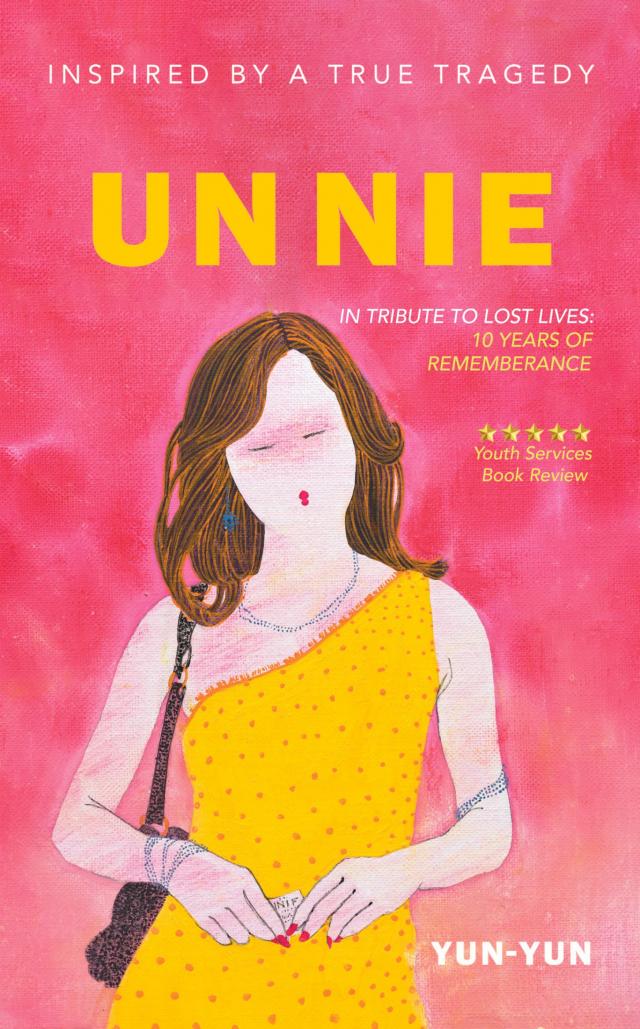


UN NIE
Yun-Yun
Copyright ©2024 by Yun-Yun
All rights reserved, except for brief quotations in critical articles or reviews. No portion of this book may be reproduced in any form or by any means without permission from the publisher. For permissions contact: yunyun.books@gmail.com
This book is a novel based on a true tragedy. The Park family is fictional, created from an amalgam of true stories of the victims’ families. Minor adaptations have been incorporated to narrate the story while drawing from a variety of sources.
The world is full of contradictions disguised as truth. Would there be such thing as an absolute truth? Truth within oneself may not be truth within the other. In this sense, I can’t say this book is the exception.
Cover painting by Choi Han-dong
Published by Libre Books
About the Book
On the morning of April 16, 2014, the Sewol ferry tragically capsized while en route from Incheon, near Seoul, to the southern resort island of Jeju in South Korea. Among the 476 passengers and crew members, 304 lost their lives, including 250 students and 11 teachers from Danwon High School who were on a school field trip.
Yun-young’s Unnie (the Korean word for 'older sister') is a teacher now missing. As Yun-young embarks on an unfamiliar journey—one she has never undertaken before—she finds herself entangled in a blend of memories and unforeseen revelations, stirring an irresistible yearning. Memories of Unnie accompany her in spirit, guiding her along the way.
About the Author
I'm a high school teacher in Korea. At times, when I observe my students immersed in laughter with their peers, I feel a sudden wave of sadness, reminded of all the young lives taken away too soon. I imagine they, too, would have laughed just like that.
Writing Unnie, my first novel, I was surprised at how easily the words flowed from me. To this day, I can't shake the feeling that the lost students were guiding me as I wrote.
Author’s Note
“Why, of all topics, the Sewol ferry ...?” This was almost everyone’s response when I announced the topic of this book.
The Sewol ferry capsized en route from Incheon, near Seoul, as it traveled to the southern resort island of Jeju in South Korea on the morning of April 16, 2014. Out of 476 passengers and crew, 304 died, including 250 students and 11 teachers from Danwon High School. They were on a school field trip.
The “Sewol ferry disaster” has become something of a taboo topic in Korea. The tragedy that once united the whole nation in grief has now turned into no less than an unexpected chasm, broken along political lines—left versus right—and giving rise to numerous rumors and myths, even conspiracy theories.
The yellow ribbon that people pinned to their chests, which was initially a symbol of hope for the safe return of the missing, has now become a symbol that hints at one’s political stance for many Koreans.
I had thought it would be painfully unfair to the victims if the harrowing loss of their lives was censored just because the tragedy has become politicized. This novel started purely from a place of agonizing grief and shame for the tragedy, with no intention to criticize or to express favor toward any political and public circles.
I hope the yellow ribbon finds its true meaning—remembrance and sympathy.
I dedicate this book to the following with all my heart:
Those young students who didn’t get to blossom.
The heroes such as the teachers and the three cabin crew members who put the young before themselves.
The other victims who we failed to fully grieve simply because they were not students.
The survivors who still suffer, including the truck drivers who were passengers and exerted their best effort to save lives.
The bereaved who live to meet their loved ones in the future.
The ones living with the ghosts of the scene, including inspectors and rescuers, especially civilian volunteer divers who dived out of selflessness, without proper support and were left with serious physical and psychological suffering.
And all whose hearts have been scarred and traumatized by guilt.
To Unnie,
who departed so young.
*Unnie : an older sister in Korean.
Table of Contents
The Island
The Paper
The Other
America
The Roof
The Meeting
Us
The School
140
A Plunge
The Dome
The Sea
Wrench
April 17, Thursday
Days
Cherry Blossoms
Thunder
The Room
The Computer
Birthday
The Story
The Island
The subway rattles along, carrying a determined young woman trying to solve problems in a workbook while leaning against its door. She doesn’t seem to notice or care that Yun-young stares at her. Yun-young assumes the woman is also headed for Noryangjin and wonders if her own Unnie looked similar to this when she also was a student, preparing for the national exam to be an English teacher.
When Unnie had come home for short visits from her place in Noryangjin, Yun-young had asked her why she didn’t leave such a huge book behind. Unnie responded with unbridled ambition, “So I can study on the subway.”
As the subway approaches her destination, the people promptly stand and fling their backpacks on their backs. The woman, who isn’t done solving the problems yet, claps her book shut, leaving a pen inside to mark her place. She moves right up against the door as if she is at the start line of a race. When the door finally slides open, she darts off, disappearing behind one of the station’s staircases. Noticing all the people hurrying around her, Yun-young speeds up her own pace so she doesn’t become the clog in the current of purposeful people. Taking exit 2, she finds herself on a foot bridge, which overlooks the dreary district packed with cram schools for a variety of state-run civil service exams. In this place, exam season never ends.
People dressed mostly in tracksuits weave swiftly through the food vendors lining the streets as they head to their cram institutes, study rooms, study cafés, et cetera. Yun-young narrowly avoids bumping into people who walk forward with their eyes on their books or their phones.
A woman hands out flyers to passersby at warp speed. Yun-young looks down at the flyer suddenly in her hand. It touts an institute that prepares people to become police officers and firefighters. This exam-oriented village (or should she call it an island?) is so far from the ordinary life that she knows. It seems every fixture here—every store, every living space—is set up for the convenience of students, to help make their dreams come true.
Visiting is part of her recent efforts to search for a trace of her Unnie, however little of her is left in this world. Their lives had veered off track too suddenly.
In the distance, the large figure of a ladybug on a tall building attracts her attention.
“A ladybug? Why is a ladybug on the building?” Yun-young was baffled.
“Maybe it’s supposed to be a symbol of good luck?” Unnie grinned. “You know what? Every morning at five, a long line of people forms outside the building entrance, hoping to get front-row seats for class.”
“What’s wrong with sitting at the back?”
“Nothing. The camera zooms in on the blackboard and TV screens project the lecturer all over the room, so there’s really no difference. Only people who get poor grades mind the little things and make a huge fuss over it. Personally, I would never want to sit so close to the teachers. They stare at us and talk so fast, they spray us with their spit. Maybe they think that the teachers’ spit will bless them or something.” Unnie shrugged, playful.
Yun-young grows quiet as she follows that imagined long line into the building. Nervous, she is drawn past the elevator and to the stairs behind the green exit sign, as if Unnie is leading her around, showing her the neighborhood. Unnie had told her how the elevator wasn’t big enough to fit all the students from both the teacher exam classes and police exam classes and that she preferred walking up the stairs. At least, she joked, she got some exercise.
Yun-young looks up at the high staircase and sees an image of Unnie looking back over her shoulders and smiling. Cheerful, she gestures that Yun-young should follow. Unnie’s steps are light and buoyant. Yun-young carries herself, one heavy step after another. By the second floor, she is already short of breath—she pauses for a moment, her vision blurry, and watches Unnie steadily climb the set of strenuous stairs.
What had the world given Unnie in return for walking up all these stairs for three years? Yun-young thinks with resentment. She widens her stride and takes two steps at a time, envisioning Unnie doing the same thing by her side. It was a habit of Unnie’s to move quickly, so that she would have more time for studying.
Making it to the fifth floor, Yun-young sees the reception desk through the slightly open doors. She wipes her eyes and pushes open the door. She takes a left turn, quick, not wishing to meet the staff’s eyes.
“The specifier is a sister of the node that dominates the head+complement sequence, indicated by ....” The most bizarre thing that she has ever heard blares out through the PA system of a classroom. Hearing this, she wonders if it could be one of the reasons that Unnie had said English teachers in Korea couldn’t carry out a conversation in English well.
“May I help you?” From behind her, a woman’s voice catches her off guard. She tur
“Oh, I’m just looking around.”
“Okay. If you want to ask questions, the reception desk is over there.”
Yun-young nods, feeling awkward. As the woman walks away, she peeks into the classroom through a small window on the door. Over two hundred students seem to have been squeezed in there, all engrossed with the lecturer. She guesses Unnie would have sat at the back, the front seats occupied by those who got in line hours before class; and perhaps she liked to sit in the corner, nearest to the wall, but she would have hated to make people stand up every time she moved to and from her seat. Yun-young pictures Unnie in the aisle seat in the back, pushing herself to be more engaged, taking notes, breathing cautiously, bothered by people seated so close together.
“I wouldn’t even sit that close to my boyfriend,” Unnie once told Yun-young. She waited for Yun-young’s mocking expression at the idea of Unnie having a “boyfriend.” Quickly, she added, “When I get one.”
“It’d be ‘more chairs, more money’ for the school,” Yun-young replied.
“I get so frustrated when I come back to class after a meal and the air keeps coming out of my mouth.”
“You mean when you burp?” Yun-young asked.
“No, not a burp. There’s no sound. It’s just air that comes out silently.”
“That’s a burp.”
Unnie ignored her sister. “When the air comes out, I hold my breath as long as I can so the smell disappears—until I have to exhale again. It’s so annoying. Ugghh!”
“Maybe they don’t smell it, you could be worrying for nothing.”
“No, I swear they smell it. They shift a bit suddenly, no matter how long I wait to exhale.”
“Go see a doctor.”
Unnie, always forthright, did go to the doctor. The doctor said that she would stop experiencing excessive burps if she started to move around more instead of sitting at the desk all day long. The solution didn’t appeal to her. Her other medical problem—the dry, scaly patches of skin on her elbows that itched—was diagnosed as psoriasis. The doctor recommended she reduce the friction between her elbow and the desk by putting a cushion under her elbow.
It is only now, when Unnie is permanently absent, that Yun-young wonders if Unnie followed any of the doctors’ recommendations, if she did anything to increase her well-being and health.
Leaving the building, Yun-young follows the GPS arrow on her phone to find Unnie’s gositel, the smallest square cubicle where Unnie lived and studied. The word was a combination of “gosi,” the difficult state exams, and “tel,” from the word motel.
She follows the map to a narrow alley and up the hill. The gositel appears directly ahead. Named “Fighting”—a typical English expression misused to express “Cheer up”—the sign depicts a cartoon character of a boy in a jubilant pose, his hands up in the air as if he has just passed an exam.
A drab yellow ochre building sits in front of her.
How it looks like one giant chicken coop with these little shabby windows. These lonely quarters were where Unnie spent her most youthful years. Reminded of Unnie’s excitement over the possibility of time travel, she wishes foolishly for a miracle where time could flow backward to reveal Unnie in there, studying.
She drags herself inside and takes her shoes off. As her bare foot touches the cold floor, a sharp tingle shoots up, straight into her heart.
A young female student, probably a part-time worker at the entrance office, looks up from her book. “Hi, may I help you?”
“Hi,” Yun-young says. “I am here to look around.”
“Oh, okay. Hold on a moment.” The girl puts her pen down, steps out of the office, and locks the door. “This way.” She promptly leads her down the hallway, like she has done this too many times.
Yun-young follows her, a knot of uneasy emotions pitted in her stomach. She tries picturing Unnie holding the doorknob of every door as if it will help her find Unnie’s room.
The girl turns around. “When’s your moving date?”
“Uh, this month,” she lies.
“Great.”
The girl’s pace gains momentum. Yun-young wonders if she is walking fast to save time, the way Unnie used to do.
The thought that Unnie’s room might not have been far from the entrance pops to mind. Unnie had once complained about the constant sound of footsteps as people came in and out of the entrance, and about how much the next-door girl’s careless door-banging annoyed her. One day, as Unnie told her, she finally mustered up the courage to put a note on her neighbor’s door: “Hello, I live next door to you. Since the wall is thin, the door bangs loud every time you shut the door. I would appreciate it if you would close it a bit more quietly. Thank you.” She didn’t forget to add, “All the best for your exam.” Since the people’s lives here rested solely on the result of their exams, the quality of concentration mattered, down to every minute of the exhaustive number of hours they studied. Abstinence from everything that distracts was a must. That’s why Unnie even got rid of her phone, for a while, and did courageous things like sending that note to her next-door neighbor. Yun-young was astounded when Unnie told her about the notes that people would put on the desks of strangers, notes that said things like, “Watch your footsteps”; “Please turn pages quietly”; “You are not the only one studying here”; “What the heck are you eating at your desk every day?”; “Please sleep somewhere else”; and “I can hear music through your earphones,” et cetera. Unnie got goosebumps when someone gave her one of those notes, but it didn’t take her long to become one of the ones who freely distributed such notes.
Yun-young fixates on the two adjacent doors, one of which she thinks could be Unnie’s. She puts her hand on the doorknob.
“No, that room is not available.” The girl looks back as if she had sensed Yun-young’s movement.
“Oh, yeah ....” Startled, she removes her hand from the knob. Maybe she just wanted to touch it.
A few doors later, the girl stops, sticks a key in a door, and jingles it a couple of times. “Here you go. This one’s available.” She smiles for the first time and opens the door wide.
Just one step into the room makes Yun-young feel suffocated. It is the tiniest cubicle she has ever seen yet it contains the bare minimum an examinee should have—a long plank nailed to a wall to serve as a shelf, a bed barely twice the size of the shelf in width, a desk and a chair.
“Good thing about this room is that it has a window.”
The way she says it, windows suggest a luxury.
“You can put your clothes in here.” She points to a tiny built-in chest behind the door. “Isn’t this nice? We don’t have many available rooms.”
Yun-young feels awkward. She doesn’t think it seems nice at all.
“Don’t you have a room with a bathroom?”
“No, not in our gositel. That’s why it’s so cheap. If you want a private bathroom, you should try the recently built ones that cost at least 500,000 won.”
“How much is this?”
“270,000 won,” she says, confident that it is a really good price.
“Can I see the public restroom then?” Yun-young asks, as if she is really looking for a room. Why does she feel as if seeing where Unnie lived and bathed would change anything about Unnie’s life?
“Yup, it’s right ahead. Follow me.” The girl leads her around another corner and stops at the end of the alley. “This is the restroom.” She turns the knob.
Yun-young pokes her head inside. The loud sound of a machine chugging filters through the closed PVC folding door.
“What’s that sound?”
“Oh, it’s a washing machine.”
Right, this is a house.
Yun-young steps inside and gives a cautious push on one of the doors of two shabby booths. It squeaks to show a toilet bowl, thankfully, instead of a squat toilet. Still Unnie, who liked things clean and tidy, would have definitely frowned upon encountering things here. Yun-young wonders if this was the reason why Unnie hadn’t let Mom and Dad visit her when they said, “Shouldn’t we see where our daughter lives?” Unnie had always told them that everything was good in her gositel, except for the room’s size. Yun-young rather hopes she has come to the wrong building. It is awful to imagine Unnie living here.






